Gold Surges Past $3,000 Again: What’s Fueling the Rally?
This week, gold prices smashed through the $3,000 barrier for the second time, igniting discussions across the financial world. But what’s driving this surge, and can it continue? Let’s break it down.
Key Points
- Gold prices have reached above $3,000 due to various economic factors.
- Global trade tensions and a weakening U.S. dollar play significant roles.
- Geopolitical risks add additional fuel to gold’s momentum.
Summary of Recent Events
The main trigger for gold’s ascent is the ongoing economic uncertainty exacerbated by U.S. President Donald Trump’s 25% tariffs on steel and aluminum. As investors seek refuge from potential market instability, gold serves as a prime safe-haven asset.
Meanwhile, the U.S. dollar struggles near a five-month low, further enhancing gold’s allure given its inverse relationship with the dollar value.
“Gold’s momentum is currently unstoppable,” says Marex analyst Edward Meir, citing technical buying and the lack of clear resistance levels.
Adding to the mix, geopolitical tensions, notably in the Middle East, have escalated. Israeli airstrikes have increased instability, driving more investors to gold.
Opinion & Analysis
Looking ahead, analysts are optimistic. With ANZ forecasting gold to reach $3,100 within three months and $3,200 in six months, the outlook is bullish. While some skepticism exists around the sustainability of this rally, the combination of tariff tensions, dollar weakness, and geopolitical factors provides a solid ground for continued growth.
Gold Price Technical Outlook
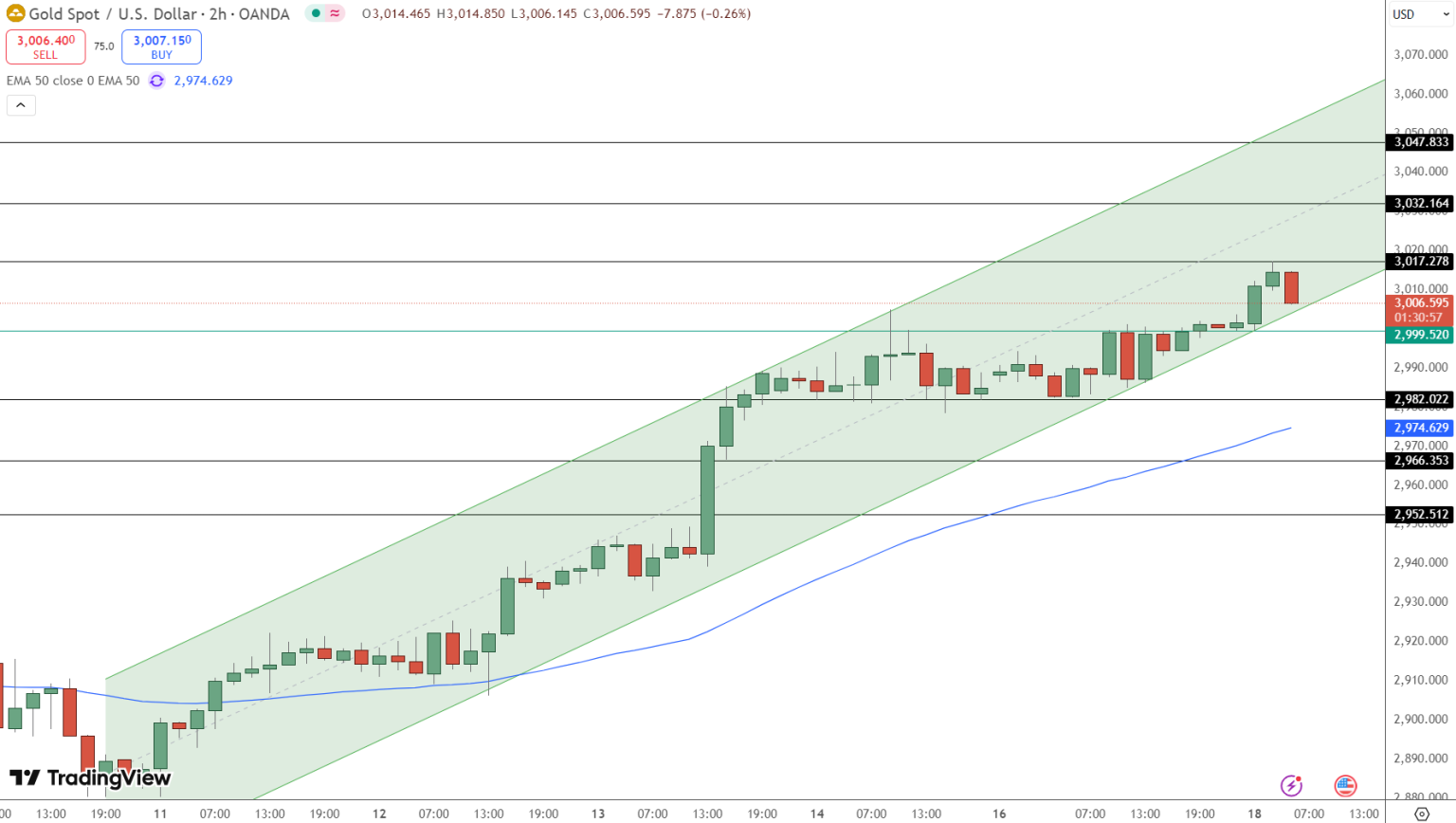
Technically, gold appears strong, currently consolidating around $3,006. A breakout above $3,017 could propel prices to new highs, targeting $3,032 and even $3,047. Support levels that traders should watch include $2,999 and $2,982.
All traders should be on the lookout for volume-backed moves to confirm potential breakouts or breakdowns around these key levels.
For more insights and forecasts, check out our free forex signals and stay updated with the FX Leaders economic calendar.