
Most broker pages lead with a headline number and hope nobody reads further. IC Trading leads with plumbing — server locations, cross-connects, commission per lot, how many open orders an account can hold — and that tells you who the broker was built for. This is a platform aimed squarely at people who run expert advisors, scalp the open, and care more about where the matching engine sits than about a welcome banner.
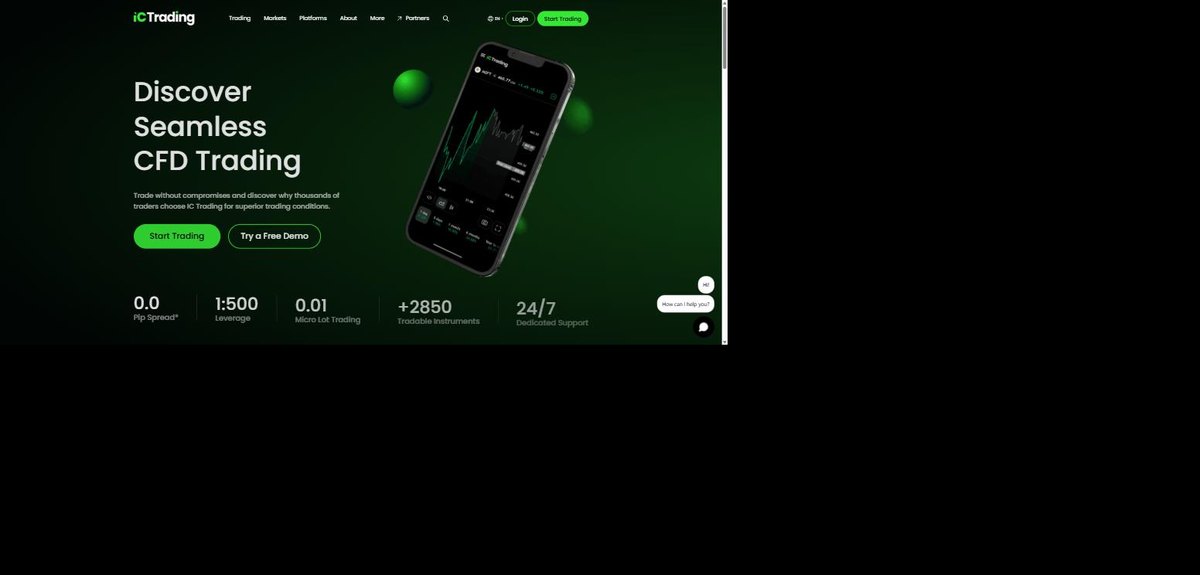
The headline conditions are easy enough to state: spreads from 0.0 pips, leverage up to 1:500, position sizes from 0.01 lots, more than 2,850 tradable instruments and support available around the clock. What follows is what sits underneath those numbers, taken directly from the broker own published pages. IC Trading publishes all of it on its site.
What IC Trading actually sells: execution, not promises
The product range covers Forex, indices, stocks, commodities, bonds, cryptocurrencies and futures — all as CFDs. Sixty-one currency pairs are available on every account type, alongside benchmarks like the S&P 500 and FTSE 100, US Treasury bonds and German bunds, and majors such as Bitcoin, Ethereum and Litecoin.
What stands out is not the breadth — plenty of brokers list thousands of symbols — but that the same conditions apply across all three account types. Micro lot trading, one-click trading, a 50% stop-out level and a swap-free option are present on every tier, not reserved for a premium plan.
Three IC Trading accounts, one $200 starting point
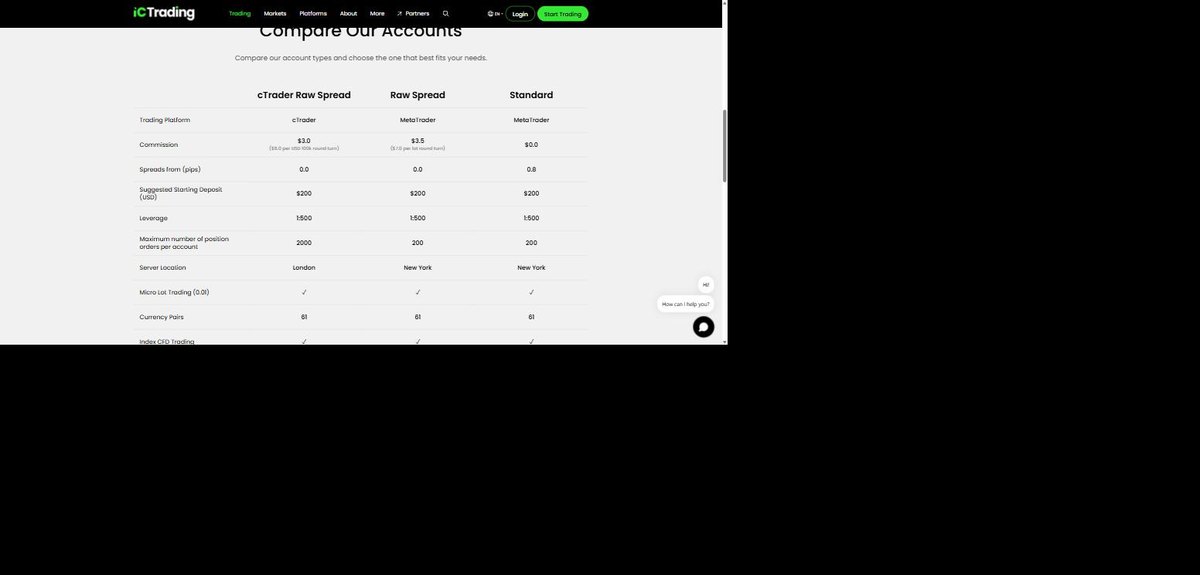
All three accounts share the same suggested starting deposit of $200 and the same 1:500 maximum leverage. What differs is the platform, the commission model and — importantly for anyone running automated strategies — the server and the order ceiling.
- cTrader Raw Spread — cTrader platform, $3.0 commission per USD 100k ($6.0 round turn), spreads from 0.0 pips, up to 2,000 open position orders, server in London, C# for custom code. Positioned for day traders and scalpers.
- Raw Spread — MetaTrader, $3.5 per lot per side ($7.0 round turn), spreads from 0.0 pips, 200 open orders, server in New York, MQL4. The most popular account, aimed at EA users and scalpers.
- Standard — MetaTrader, zero commission, spreads from 0.8 pips, 200 open orders, New York server. The straightforward option for traders who would rather see one number than two.
The 2,000-order ceiling on cTrader is the detail worth noticing. Grid and basket strategies bump into order limits long before they bump into margin, and ten times the usual headroom is a real difference rather than a marketing line. There is also a dedicated swap-free account for traders of religious faith, and a free demo for anyone who wants to test before funding anything.
The execution stack behind IC Trading
This is where the broker spends its explanation. Trade servers run on enterprise-grade hardware inside the NY4 data centre in New York, and they are collocated with the data servers of the pricing providers in the same facility. Dedicated fibre optic cross-connects link the two, which is the standard way to shave milliseconds off a quote-to-fill round trip.
On the pricing side, the technology sorts and ranks quotes from multiple providers and their pricing tiers, so a large order can be filled across several sources at the best available price rather than slipping down one provider book. Order sizes run from 1 micro lot — 1,000 units of base currency — up to 200 lots, or 20 million units, through the same bridge.
None of this is unique to IC Trading, but the combination of NY4 collocation, a London option for cTrader users and published order ceilings is more transparency than most offshore brokers offer.
Scalping, hedging and EAs are all allowed at IC Trading
Plenty of brokers advertise tight spreads and then bury restrictions in the terms: a minimum holding time, a minimum distance between the market price and a pending order, a quiet ban on news trading. IC Trading publishes the opposite position. Under “trading styles allowed” the answer is All, and under “order distance restriction” the answer is None — on every one of the three account types.
Scalping, hedging and automated trading are explicitly permitted. For anyone who has had a strategy quietly throttled by a dealing desk, that single line in the comparison table is worth more than a deposit bonus.
MT4, MT5 and cTrader: pick the tool, not the compromise
Three platforms are offered, and the published comparison shows the trade-offs plainly rather than steering everyone to one product.
- MetaTrader 5 — the broadest instrument coverage, including Forex, commodities, indices, digital currency, stocks and bonds. Multi-asset trading with enhanced charting and order management.
- cTrader — the only one of the three with multi-monitor support with detachable charts and cloud-based management of profiles and settings. Advanced charting, one-click trading, C# for custom indicators and cBots.
- MetaTrader 4 — still the most widely used platform in retail forex, and here it covers Forex, commodities, indices, digital currency, futures and bonds.
All three run on desktop, browser and mobile, all three support expert advisors, strategy backtesting, customisable charts and indicators, access to historical data, and stop-order and margin-control risk tools. Beyond the big three there is a web trader, a VPS service, copy trading and a ZuluTrade integration.
Complimentary VPS: the IC Trading perk that matters for EA traders
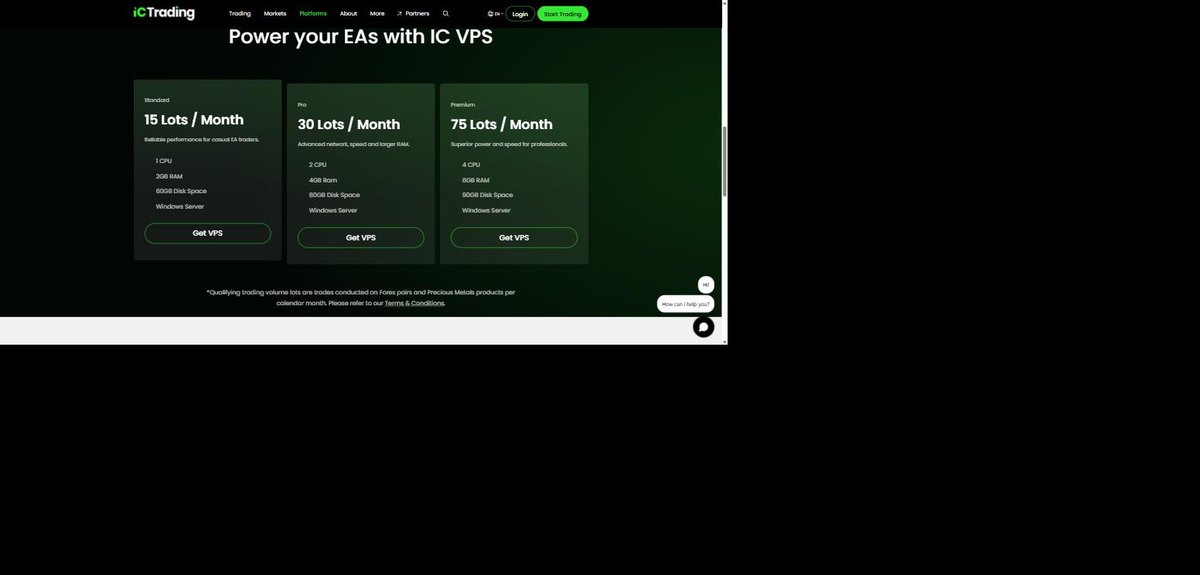
A VPS is not glamorous, but for anyone running an expert advisor it is the difference between a strategy that trades and a strategy that stops the moment a laptop sleeps or a home connection drops. IC Trading runs its own VPS on Windows Server with execution speed quoted at above 20ms, and offers it free of charge to clients who meet a monthly trading volume.
- Standard — 15 lots per month. 1 CPU, 2GB RAM, 60GB disk. Aimed at casual EA traders.
- Pro — 30 lots per month. 2 CPU, 4GB RAM, 80GB disk. More network and memory headroom.
- Premium — 75 lots per month. 4 CPU, 6GB RAM, 90GB disk. For traders running several strategies at once.
The qualifying volume counts trades on Forex pairs and precious metals within a calendar month, so a trader who is active anyway is effectively getting hosting thrown in. Connecting is a four-step process: download the RDP file, open the remote desktop connection, log in and trade on MT4 or MT5. The VPS tiers and conditions are listed on the site.
Funding an IC Trading account in ten currencies
Accounts can be denominated and funded in AUD, USD, EUR, GBP, SGD, NZD, JPY, HKD, CHF and CAD, which removes a conversion step for most of the markets the broker serves. Processing times are published per method:
- Card and e-wallet payments — instant
- Bank transfer — 2 to 5 business days
- Cryptocurrency (USDT, USDC, BTC, ETH) — instant to 2 hours
- Local payment methods (BRL, VND, PHP, JPY, MYR, THB) — instant to 24 hours
On fees and custody the published position is straightforward: IC Trading does not charge additional fees for deposits, though intermediary or international banks may add their own, particularly on wire transfers and cards. Client money is held in a segregated client trust account with top-tier international banks, and electronic payments are processed over SSL encryption. Funding methods and processing times are published in full.
Insurance, licensing and risk: the IC Trading fine print
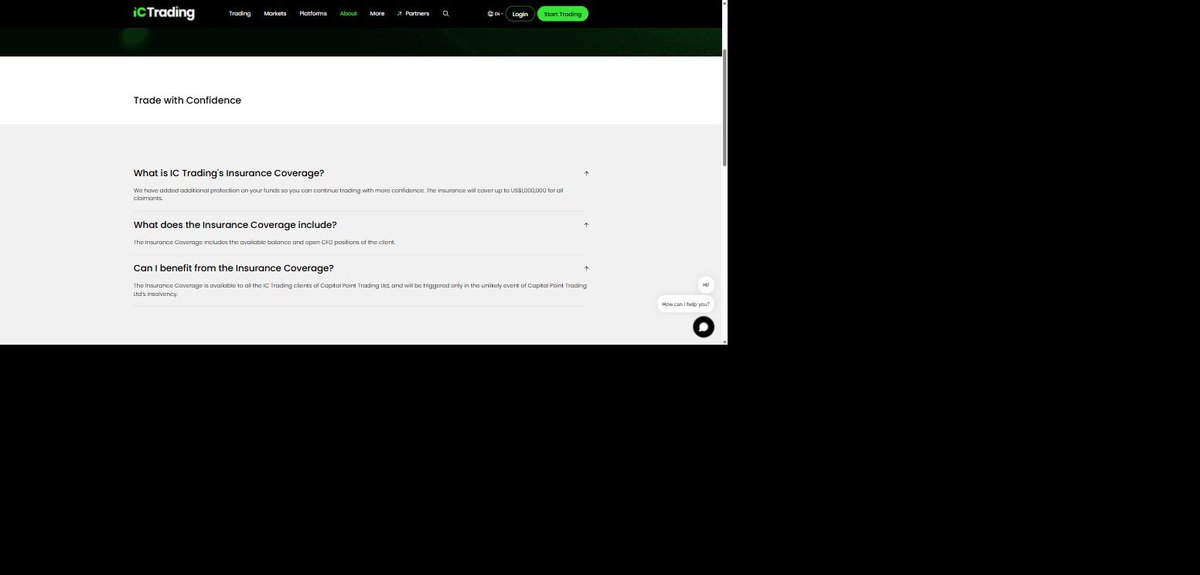
Insurance. IC Trading carries insurance cover of up to US$1,000,000 for all claimants. The cover includes a client available balance and open CFD positions. Two qualifications matter and the broker states both: it applies to clients of Capital Point Trading Ltd, and it is triggered only in the unlikely event of that company insolvency. This is private insurance arranged by the broker, not a government-backed compensation scheme such as the UK FSCS or the Cyprus ICF, and the ceiling is shared across all claimants rather than granted per account.
Licensing. The operating entity is Capital Point Trading Ltd, regulated by the Financial Services Commission of Mauritius (FSC) under licence number GB21026834. The FSC supervises financial services in Mauritius and requires licensees to demonstrate ongoing compliance, which IC Trading says it verifies with an independent auditor. Anti-money-laundering and KYC procedures follow the Mauritian Financial Intelligence and Anti-Money Laundering Act. It is worth being clear about what this does and does not mean: an FSC Mauritius licence is an offshore licence and does not carry the same investor-protection framework as a top-tier regulator such as the FCA, ASIC or CySEC. It also means no retail leverage cap — the 1:500 on offer here would not be permitted to a retail client in the UK, EU or Australia.
Risk. The broker own risk warning is unambiguous, and it belongs in any honest write-up: CFDs are complex instruments and come with a high risk of losing money rapidly due to leverage. The majority of retail investor accounts lose money when trading CFDs. You should consider whether you understand how CFDs work and whether you can afford to take the high risk of losing your money, and there is a possibility of losing all of your initial capital.
Restricted countries. Capital Point Trading Ltd does not provide services to residents of the United States of America, Canada, Israel, New Zealand, Iran and North Korea, or any country where such distribution or use would be contrary to local law. The company states it does not target jurisdictions where its services are prohibited, and that checking local rules is the responsibility of the person accessing the site.
Who IC Trading fits best
Four groups get clear value from what is on offer here:
- EA traders — the free VPS, the NY4 servers and the unrestricted automated trading policy are the whole pitch, and they land.
- Scalpers — 0.0 pip raw spreads, no order distance restriction and no minimum holding time, with cTrader on a London server for anyone trading European hours.
- Grid and basket strategies — the 2,000 open-order ceiling on the cTrader account is unusually generous.
- MT4 loyalists — a way to keep a familiar terminal and a decade of custom indicators while moving to raw-spread pricing.
Traders who want the protection of a top-tier regulator, or who are new enough that 1:500 leverage is a hazard rather than a tool, should weigh the licensing section above carefully before funding anything. Starting on the free demo costs nothing and answers most questions about whether the platform suits a given strategy. For comparison with other brokers covered here, see our Zuperior review and our XM review.
Account types, live spreads and the full legal documentation are available directly from IC Trading.


