
The DeepCharts wordmark, taken from the vendor site
Order flow software sits in an awkward corner of the retail trading market. The charts are expensive, the feature lists are dense with jargon, and the price you actually pay depends on which billing term you click. DeepCharts is one of the more visible names in that corner, and it sells three separate products rather than one subscription, which makes the bill harder to work out than it first looks.
This review does the arithmetic. Every plan, every billing term and every discount badge was opened and recorded, then multiplied out to see whether the headline numbers match the totals the checkout quotes. Several do not, and in every case the gap is small, checkable and worth knowing before you commit to a year. Everything below describes what DeepCharts publishes on its own pages, read in mid-November 2026 while a Birthday Sale countdown was running sitewide.
What DeepCharts is, and the three products it sells
DeepCharts is desktop and web charting software built around order flow rather than candlesticks alone. The company describes it as a way to see “the footprints of smart money” through footprint charts, volume and delta profiles, depth of market, and large-trade detection. DeepCharts is analysis software, not a broker. DeepCharts does not hold your money, does not route your orders by itself and does not take the other side of your trade; it reads a market data feed you supply and draws on it.
What complicates the price is that DeepCharts is not one product. DeepCharts sells three, each with its own pricing page:
- DeepChart, the main charting application: order flow, footprint, volume, delta profile, big trades and gamma overlays, in three tiers called Orderflow, Advanced and Pro.
- DeepDom, the depth-of-market product: a liquidity heatmap with MBO integration, a liquidity tracker, stoprun and iceberg detection, a market regime read, a backtester and a journal, sold as a single plan.
- DeepGamma, options positioning: gamma exposure profiles, a GEX heatmap, hedging profiles and gamma levels. The web version is sold in two tiers, Prime and Institutional.
The products overlap deliberately. Higher DeepChart tiers bundle months of DeepDom and DeepGamma under a heading the site calls “Deep Rewards”, which makes any like-for-like price comparison harder. The table below strips the bundling out.
DeepCharts pricing: every plan and billing term in one table
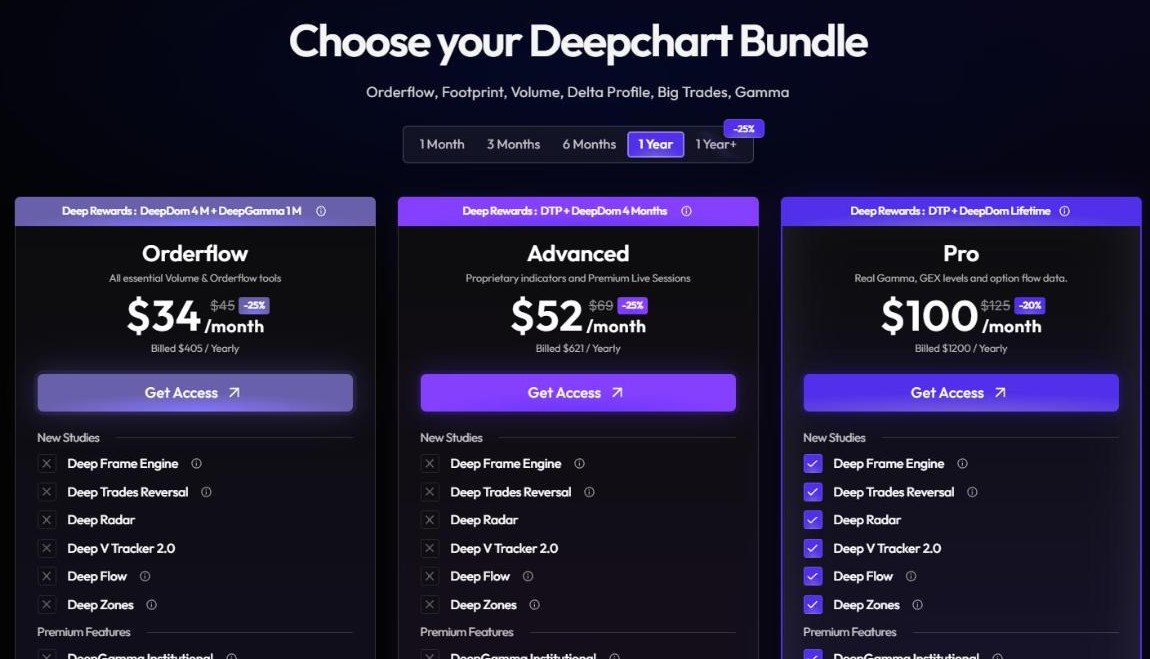
The DeepChart annual plans, with the discount badges the vendor displays (screenshot from deepcharts.com)
Each DeepCharts pricing page offers several billing terms as tabs, and the list price itself changes with the term, not only the discount. The figures below are the ones displayed on the DeepCharts site during this review, with the sale badge shown as the vendor shows it.
| DeepChart term | Orderflow | Advanced | Pro |
|---|---|---|---|
| 1 month | $75 to $56/mo (-25%), billed monthly | Coming Soon | Coming Soon |
| 3 months | $66 to $50/mo (-25%), $149 total | $89 to $67/mo (-25%), $200 total | $139 to $111/mo (-20%), $334 total |
| 6 months | $55 to $41/mo (-25%), $248 total | $79 to $59/mo (-25%), $356 total | $132 to $104/mo (-20%), $624 total |
| 1 year | $45 to $34/mo (-25%), $405/yr | $69 to $52/mo (-25%), $621/yr | $125 to $100/mo (-20%), $1,200/yr |
| 1 year + | Lifetime $1,297 one-time | Orderflow + DeepDom lifetime $1,697 one-time | Pro 2 Years $125 to $92/mo (-25%), $2,197 total |
The two companion DeepCharts products are simpler. DeepDom runs $39 down to $29 a month on the annual term, billed $351 a year, with a Lifetime Addon at $495 down to $371. DeepGamma Web offers Prime at $49 down to $37 a month, billed $441 a year, and Institutional at $69 down to $52 a month, billed $621 a year.
One note the vendor attaches to the two-year Pro card is worth repeating because it is time-limited: the site states that Pro 2 Years “is available only during the Birthday event, with limited spots”. If you are reading this after the countdown has run out, expect that row to be gone. The current DeepCharts pricing page is the only reliable check.
Where the DeepCharts discount badges and the billed totals part ways
The banner across the top of every DeepCharts page reads “up to -25% to all offers”, and “up to” is doing real work. Orderflow, Advanced, DeepDom and DeepGamma all carry -25% badges; the Pro tier carries -20% on the three-month, six-month and one-year cards, reaching -25% only on the two-year card. The most expensive monthly plan receives the smallest percentage cut.
Multiply each badge out and all but one DeepCharts card lands where it should. Pro at three months is $139 less 20%, which is $111.20, and the card shows $111. Pro at one year is $125 less 20%, which is exactly $100, and the card shows $100. Pro at six months is $132 less 20%, which is $105.60 a month or $633.60 over the term. The card shows $104 a month and bills $624, about ten dollars less than its own badge implies.
That is the single card on the DeepCharts site where the stated list price, the stated discount and the billed total do not reconcile, and it errs in the buyer’s favour. Every other combination checks out once you allow for rounding to whole dollars.
Two smaller DeepCharts rounding quirks matter if you compare plans on the per-month figure. On the annual Orderflow plan the true monthly cost is $405 divided by twelve, or $33.75, displayed as $34; on DeepDom it is $351 divided by twelve, or $29.25, displayed as $29. The two round in opposite directions, so the big bold price overstates one and understates the other by a quarter of a dollar a month.
Monthly billing exists on only one DeepCharts plan
This is the finding most likely to change what you buy. Open the 1 Month tab on the DeepChart pricing page and only the entry tier has a price: Orderflow at $75 down to $56 a month. Advanced and Pro both read “Coming Soon”. Open the same DeepCharts tab on the DeepDom page and the card reads “Not Available”.
So the shortest commitment available for anything above the entry tier is three months. A trader who wants to try Advanced for its live sessions, or DeepDom for its heatmap, is choosing a $200 or $351 outlay rather than a one-month trial. Nothing is hidden, but it is only visible if you click the tab.
It also makes the annual discount easy to quantify on the one plan where both options exist. Orderflow at $56 a month comes to $672 over twelve months against $405 for the annual plan, a difference of $267, or 39.7%. That is a large gap by subscription-software standards for DeepCharts, and it is the clearest argument the pricing page makes for committing to a year.
The DeepCharts lifetime maths: $1,297, $371 and a $29 gap
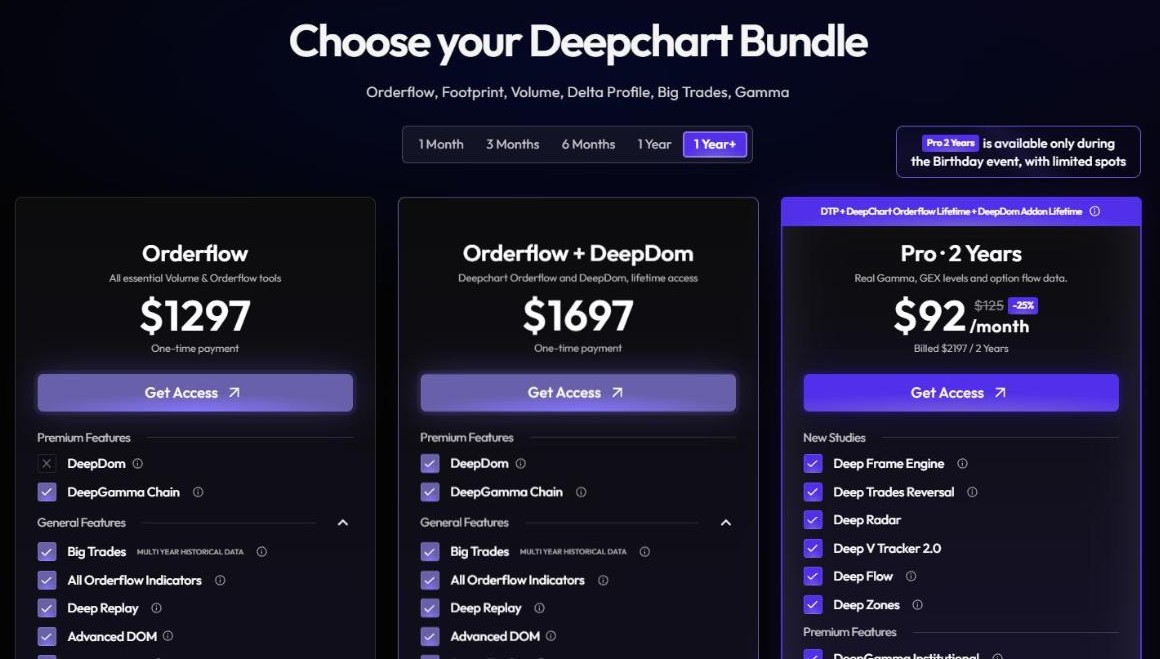
The 1 Year plus tab, where the lifetime licences and the two-year Pro plan appear (screenshot from deepcharts.com)
Behind the 1 Year + tab the DeepCharts offer changes shape entirely. Two cards become one-time payments: Orderflow lifetime at $1,297, and Orderflow plus DeepDom lifetime at $1,697. Neither carries a discount badge, which suggests the lifetime prices sit outside the sale while the subscriptions sit inside it.
Set each against the annual plan it replaces and the payback periods are very different:
| One-time option | Price | Annual equivalent | Break-even |
|---|---|---|---|
| Orderflow lifetime | $1,297 | $405/yr | 3.20 years |
| DeepDom Lifetime Addon | $371 | $351/yr | 1.06 years |
| Orderflow + DeepDom lifetime | $1,697 | $756/yr combined | 2.24 years |
The DeepDom add-on is the striking one of the DeepCharts range. At $371 it costs twenty dollars more than a single year of the same product at $351, so it pays for itself in roughly thirteen months. Anyone who already knows they want DeepDom for more than a year has an unusually short payback on that card.
The combination is where the arithmetic gets interesting. The DeepDom card describes the Lifetime Addon as “Added to your Deepchart License”, and the Orderflow lifetime card shows DeepDom explicitly unticked. Buy the two lifetime items separately at the prices showing during this review and the total is $1,297 plus $371, or $1,668, against $1,697 for the bundle that contains both: the bundle is $29 more expensive.
That gap depends entirely on the sale. At the add-on’s list price of $495 the separate route costs $1,792 and the bundle is $95 cheaper. The bundle is good value at list prices and slightly behind at sale prices, so price both cards on the day. Both options sit on the same DeepCharts pricing page, one tab apart.
Inside DeepChart: the order flow and footprint toolset
The charting application is the reason to buy into DeepCharts at all. The feature lists are long, but they divide cleanly into three groups that map onto the three tiers.
General features appear everywhere: all order flow indicators, big trades, multi-year historical data, Deep Replay, and an advanced DOM. These are ticked on every card including the entry plan, so the core footprint-and-volume workflow is available at $34 a month on the annual term.
Premium features are the named proprietary models: Deep Trades, Deep V-Tracker, the Pattern Builder with auto-backtester, and three DeepGamma layers called Institutional, Prime and Chain.
New Studies is the group worth checking carefully. Six items sit under that heading on every card: Deep Frame Engine, Deep Trades Reversal, Deep Radar, Deep V Tracker 2.0, Deep Flow and Deep Zones. On the annual tab all six are ticked only on Pro, the $1,200-a-year plan; Orderflow and Advanced show them crossed out. If a specific new study is the reason you are buying, that detail decides the tier for you.
One other gated DeepCharts item is the AI assistant: 1,000 tokens a month on Orderflow, 2,000 on Advanced and 3,000 on Pro. Measured against the annual prices, the first extra thousand tokens costs $216 a year and the second costs $579, so the allowance is not a linear upgrade.
DeepDom: liquidity heatmap, MBO and a Windows-only note
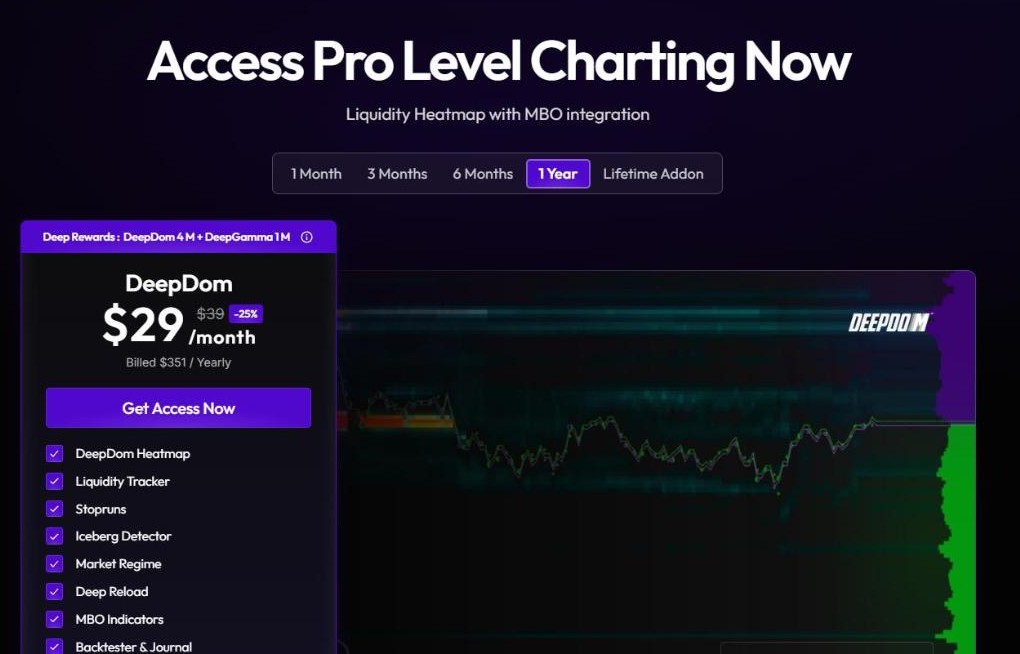
The DeepDom plan and its liquidity heatmap (screenshot from deepcharts.com)
DeepDom is the depth-of-market half of the DeepCharts toolkit, sold separately from the charts: the DeepDom heatmap, a liquidity tracker, stoprun detection, an iceberg detector, a market regime read, Deep Reload, MBO indicators, a backtester with journal, and a freeze feature for holding a snapshot while the book keeps moving.
Two extras ship with it that are easy to miss on the DeepCharts card: an Orderflow Mastery Course, described by the vendor as an “8+ hours course that takes you from knowing absolutely 0 about orderflow, to mastering orderflow and all its tools”, and access to a private Discord server.
That course description sits a little oddly beside the terms of service, which state that the software “is intended for professional users, meaning individuals with adequate experience, technical competence, and understanding of financial-market analysis tools”. Both statements come from the vendor and both are reproduced here as written; the pairing reads as a product aimed at serious users that also ships a beginner on-ramp.
Platform support is not uniform across the DeepCharts range and the vendor labels each product differently. The DeepDom page carries the note “Available for Windows only”. The DeepChart lifetime tab says “Available for Windows, or on Mac via Parallels”. DeepGamma is marked “Available on Deepcharts Desktop or Web Version”, which makes the gamma tooling the only part of the line a Mac user can reach without a virtual machine.
DeepGamma: GEX from tagged CBOE data, and what Prime leaves out
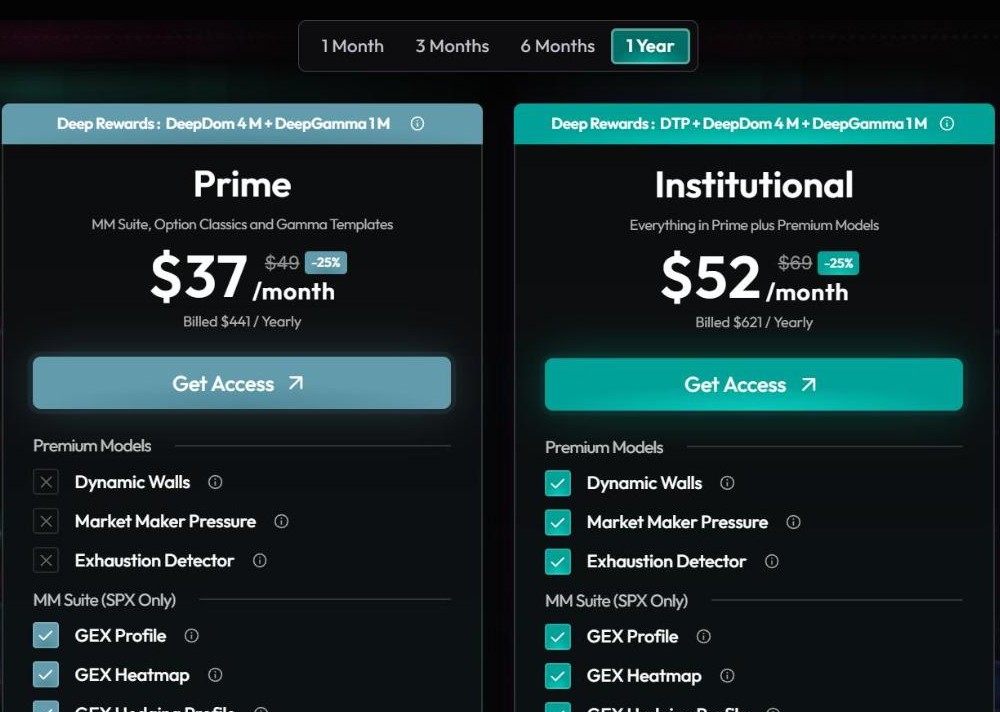
DeepGamma Web Prime beside Institutional, with the three Premium Models unticked on the cheaper plan (screenshot from deepcharts.com)
DeepGamma is the options-positioning product in the DeepCharts range. The vendor states that its gamma exposure is “calculated from tagged CBOE data (SPX only)”, which is a precise claim and a narrow one: the headline GEX model is built for a single index rather than the whole options market. A separate group the site labels Option Classics covers SPX, NDX, QQQ and SPY.
The DeepCharts web version is sold in two tiers and the split between them repays a close look. The page subtitle advertises the product as “GEX Profile, GEX Heatmap, Exhaustion Detector, Dynamic Walls”. On the plan cards, however, Dynamic Walls, Market Maker Pressure and Exhaustion Detector are all crossed out on Prime at $37 a month and ticked only on Institutional at $52 a month.
So two of the four features named in the product’s own strapline are not in the cheaper plan. Prime still carries the GEX Profile, GEX Heatmap, GEX Hedging Profile, Big Flows, Total GEX Summary, Net Flow, Option Delta and Gamma Levels, a substantial toolkit in its own right. But a reader who picks Prime on the strength of the subtitle will not find the Exhaustion Detector or Dynamic Walls in it, and the $15 a month between the plans is what closes that gap.
Which data feeds and brokers DeepCharts connects to
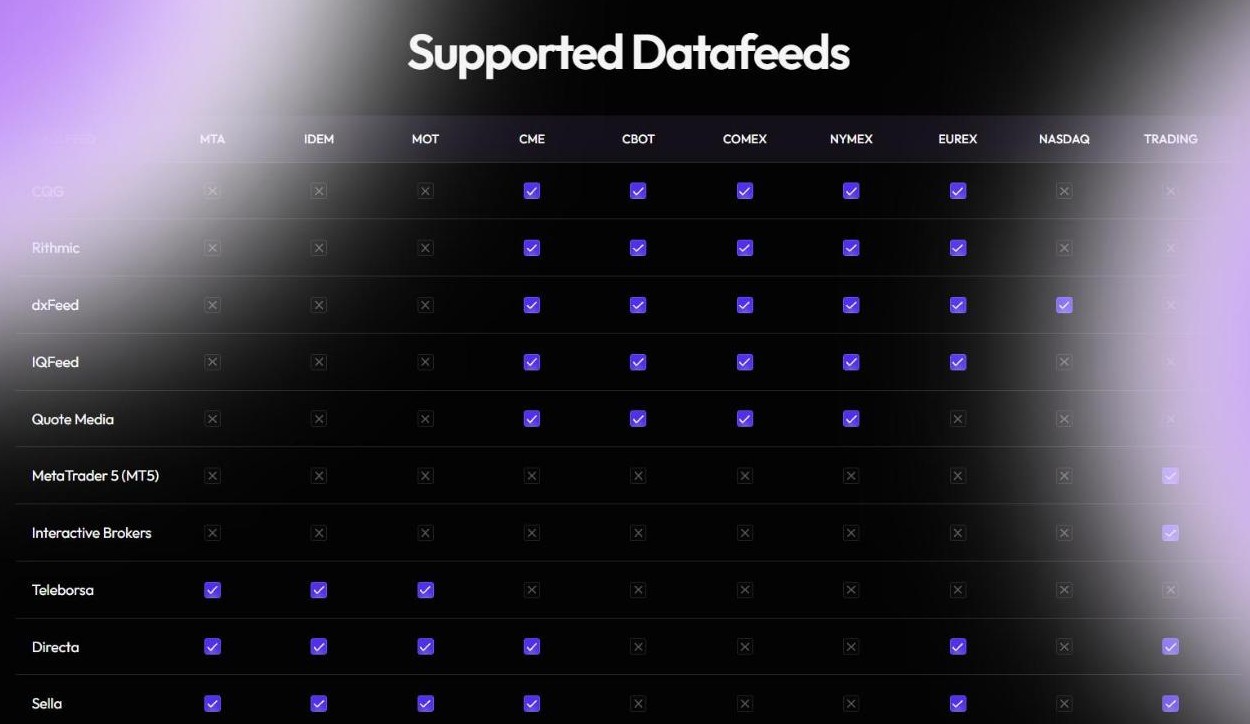
The supported datafeeds matrix, provider by provider and exchange by exchange (screenshot from deepcharts.com)
Because DeepCharts is software rather than a broker, it needs a market data feed and an execution route, and DeepCharts publishes a matrix showing exactly which provider reaches which exchange. It rewards reading column by column.
The professional feeds supported by DeepCharts cluster tightly on the US futures exchanges. CQG, Rithmic and IQFeed each tick CME, CBOT, COMEX, NYMEX and EUREX, and each is crossed out on NASDAQ. Quote Media covers the four US futures venues but not EUREX. dxFeed is the only provider in the matrix that ticks NASDAQ alongside the futures exchanges, so an equities-leaning workflow narrows the choice considerably.
MetaTrader 5 and Interactive Brokers are ticked only in the column the vendor labels TRADING, with every exchange column crossed out. Read literally, that makes them execution routes inside the platform rather than sources for the exchange data the footprint charts consume. The Italian venues on the left of the matrix, MTA, IDEM and MOT, are served only by the Italian brokers in the lower rows: Teleborsa, Directa, Sella, IWBank and WeBank.
The practical upshot: before paying for any plan, find your own broker or feed in that matrix and check the specific exchange you trade. The supported feeds are listed in full on the vendor site.
Who builds, sells and bills DeepCharts
The DeepCharts terms and conditions, last updated 8 May 2026, set out a structure that is more layered than most software purchases and is worth understanding before money changes hands. Three different parties are named.
| Party | Role, as the terms describe it |
|---|---|
| ACFV Tech Solutions FZ-LLC | The “official commercial operator”, which “acts solely in the capacity of an international marketing agent and distributor” and “does not develop, own, operate, or control the underlying software” |
| Volumetrica Trading S.R.L. | The technology provider, which “exclusively” develops, owns and maintains all software, website functionality, algorithms and technological components |
| Paddle and Whop | The Merchants of Record, “solely responsible for billing, invoicing, tax calculation, payment processing, refunds, chargebacks, and the handling of any transaction related disputes” |
None of these DeepCharts entities is a financial regulator, and none should be read as one. DeepCharts sells analysis software, so there is no brokerage licence to look up, no segregated client money and no compensation scheme behind the purchase, because none of those mechanisms apply to a software vendor. That is normal for the category, but it is a different footing from buying through a regulated broker.
Where those checks do matter is on the broker you connect the software to. The National Futures Association publishes a standing investor advisory on verifying a firm before you fund an account, and its BASIC database is the place to confirm a futures broker’s registration. Checking a software vendor’s corporate structure and checking your broker’s registration are two different jobs.
Risk warning, refunds and jurisdiction
DeepCharts repeats a risk warning in the footer of every page on the site. It is reproduced here exactly as written:
“Tools for futures, currency & options involves substantial risk & is not appropriate for everyone. Only risk capital should be used for trading. Testimonials appearing on this website may not be representative of other clients or customers and is not a guarantee of future performance or success.”
A longer DeepCharts risk disclaimer, last updated 22 October 2025, adds that “there is a high risk of losing some, all or even more than all of the initially invested capital”, and that the company “does not provide personalized investment advice or recommendations regarding the suitability of any particular trading strategy or financial instrument”. Nothing in this review is advice either, and no charting tool changes the arithmetic of leverage.
Restricted countries are not listed. Rather than publishing a country list, the risk disclaimer says the content “is intended for use by individuals in jurisdictions where such content and activities are permitted by local law” and that users “are responsible for ensuring that their use of our educational content complies with the legal and regulatory requirements applicable in their jurisdiction”. The duty sits with the buyer. The terms add that disputes “are governed by the laws of the United Arab Emirates” with “exclusive jurisdiction” lying with the Courts of Dubai, and that liability is “limited to the amount paid for the product or service”.
The DeepCharts refund terms deserve a careful read, because they interact with one of the selling points. Refunds are issued by Paddle or Whop under their own policies and “may be considered within fourteen (14) days only if the user has accessed introductory or minimal content exclusively”. Accessing advanced materials, downloadable resources or member-only content “may void automatic refund eligibility”. A dedicated clause adds that if a client “attends, views, or accesses any live session, whether live or via replay, the purchase may become immediately non-refundable”.
Set that beside the Advanced tier, whose one-line description is “Proprietary indicators and Premium Live Sessions”, and the tension is plain: watching the feature you upgraded for may close the refund window on the upgrade. Both statements are the vendor’s own.
Who DeepCharts fits, and who should wait
DeepCharts fits a futures trader on CME, CBOT, COMEX, NYMEX or EUREX who already runs CQG, Rithmic, IQFeed or Quote Media, works on Windows, and wants footprint and depth-of-market tooling without assembling it from parts. It fits an SPX options trader who wants gamma exposure drawn from tagged exchange data, provided the Institutional tier is in budget. And it fits anyone who has already decided DeepDom belongs in their workflow for the long run, because that lifetime add-on breaks even in about thirteen months.
DeepCharts is a harder call for a trader on a Mac who does not want to run Parallels, since only the gamma web version avoids that; for anyone whose exchange is missing from the feeds matrix, a question to settle before paying rather than after; and for someone who wants to sample the upper tiers cheaply, because monthly billing stops at the entry plan.
And DeepCharts is a harder call for a trader who is new to order flow. The bundled course is explicitly pitched at beginners, but the terms describe the product as built for users with “adequate experience, technical competence, and understanding of financial-market analysis tools”, and the cheapest realistic year still runs into the hundreds of dollars.
How this review was done
This is a desk review. No account was opened, no licence was bought and no live session was attended, so nothing here is a claim about how the software performs in a trading session. What was done instead: every DeepCharts pricing tab on all three product pages was opened and recorded, the terms and the risk disclaimer were read in full, the supported datafeeds matrix was read cell by cell, and each displayed price was multiplied out against its own billed total.
All DeepCharts figures were captured in mid-November 2026, while a sitewide sale with a visible countdown was running. Every quotation above is the vendor’s own wording, marked as such, and where its pages disagree with each other both versions appear here rather than an average.
The short version
DeepCharts is a serious order flow suite with an unusually transparent datafeed matrix and an unusually layered corporate structure. The DeepCharts software side looks substantial: footprint, volume profile, depth of market, replay and a gamma product built on tagged exchange data, with real feature differences between the tiers.
The DeepCharts pricing side rewards attention. The sale is “up to” 25% and the Pro plans mostly get 20%; one Pro card bills about ten dollars less than its own badge implies; monthly billing exists on exactly one plan; and at sale prices the lifetime bundle costs $29 more than the same two lifetime items bought separately. None of that is a reason to avoid DeepCharts. All of it is a reason to price your own configuration on the day rather than trusting the big bold number on the card.
Overall: 4.6 / 5. Deep, well documented tooling with a pricing page that needs a calculator. You can check the current DeepCharts plans and the live sale here.


