

An IQ Capital payout is the only number that matters once you are funded. Everything before it is a fee you have already paid; everything after it is money in your account. IQ Capital publishes the whole IQ Capital payout mechanism in open tables rather than burying it in a terms document, which makes it unusually easy to work out in advance exactly what you will be paid, when, and what could stop it.
This review reads that mechanism end to end. The four conditions that gate every IQ Capital payout, the per-request caps, the 90/10 split in actual dollars, the processing time, the fees that come out first, and the breach rules that can erase an unpaid balance. Every figure below was read from the public IQ Capital website on 21 October 2026, with no account bought and no trade placed.
What an IQ Capital payout actually is
IQ Capital is a proprietary trading firm, not a broker. Its own disclosure is explicit: traders do not invest their own capital, and trading happens in simulated evaluation environments or in proprietary funded accounts under defined rules and risk limits. An IQ Capital payout is therefore not a withdrawal of your balance; it is your share of profit generated on the firm’s capital, released to you under the firm’s rules. That is what an IQ Capital payout is.
That distinction decides how to read everything else. There is no deposit to get back, so the downside of the relationship is the fees you have paid, and the upside is governed entirely by the IQ Capital payout mechanism. The IQ Capital product page lists the account sizes and what each one costs before any of this applies.
The company publishes headline numbers for the programme: more than 20,000 funded traders, traders in 52 countries, and more than 3.5 million US dollars paid out. Those are company claims, not audited figures, and this review reports them as such.
The four conditions behind every IQ Capital payout
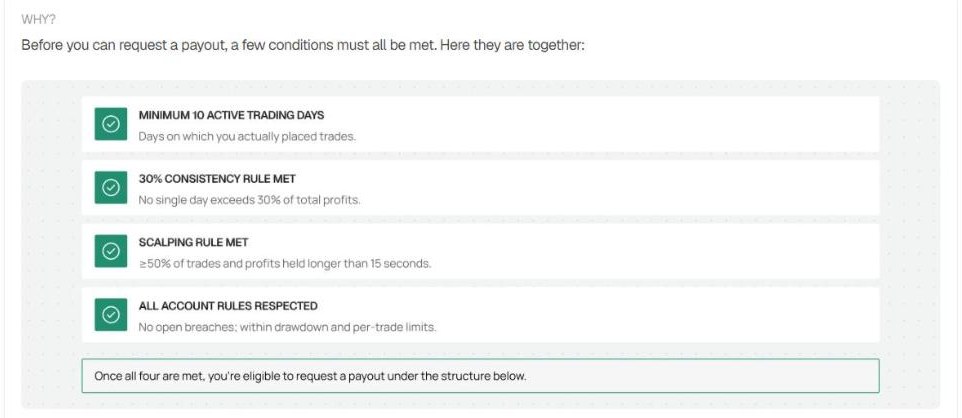
IQ Capital gates each IQ Capital payout behind four conditions that must all be satisfied at once. They are published together on one card, which is more transparent than most firms manage.
Minimum 10 active trading days. Days on which you actually placed trades, not calendar days. This is the clock on your first IQ Capital payout and it is the condition most new funded traders underestimate.
The 30% consistency rule met. No single day may account for more than 30% of your total profits. One outsized day does not disqualify you permanently; it simply means you keep trading until your total profit is large enough that the day falls back under 30%.
The scalping rule met. At least 50% of trades and profits must be held longer than 15 seconds. This is a published threshold with a number attached, not a vague anti-abuse clause.
All account rules respected. No open breaches, and you must be inside the drawdown and per-trade limits at the moment you request. The firm states plainly that once all four are met you are eligible to request a payout under the structure below.
How much each IQ Capital payout releases
The second thing to understand is that eligibility and amount are two separate questions. Meeting the four conditions makes you eligible for an IQ Capital payout; a different rule decides how much comes out.
Each IQ Capital payout may include up to 50% of total profits. The remainder stays in the account. Requests are made in USDC or in US dollars. So a trader sitting on 4,000 dollars of profit is looking at an eligible amount of 2,000 dollars on that request, not 4,000, before the split is applied.
IQ Capital frames this as compounding rather than as a restriction, and the framing is not unreasonable: the half that stays in the account is still working capital you can trade. But a trader planning around an IQ Capital payout should model the 50% rule first and the profit split second, in that order, because applying them the other way around overstates the cash.
The per-request caps that grow with your IQ Capital payout count
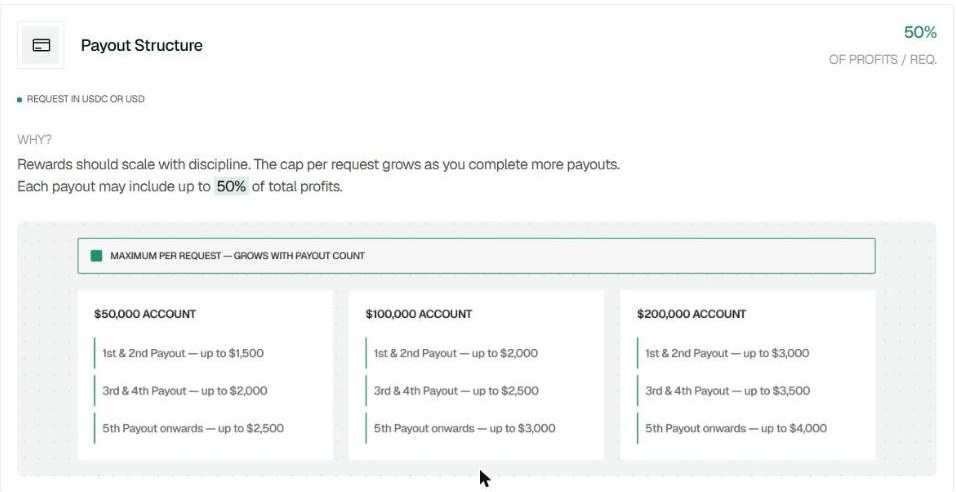
On top of the 50% rule sits a hard dollar cap per request, and this is the part of the IQ Capital payout structure that is hardest to find anywhere else. The cap rises as you complete more payouts, which rewards staying with the firm rather than taking one large IQ Capital payout and leaving.
| Request | 50K account | 100K account | 200K account |
| 1st and 2nd payout | up to 1,500 USD | up to 2,000 USD | up to 3,000 USD |
| 3rd and 4th payout | up to 2,000 USD | up to 2,500 USD | up to 3,500 USD |
| 5th payout onwards | up to 2,500 USD | up to 3,000 USD | up to 4,000 USD |
Two notes on reading this table. The 200,000 account column appears on the Crypto and CFD side of the rules; the Futures side publishes the same 50K and 100K figures without a 200K column. And the cap is a ceiling, not an entitlement: your actual IQ Capital payout is the smaller of the cap, 50% of your profits, and your profit share.
Worked through, the first IQ Capital payout on a 50,000 account is capped at 1,500 dollars of eligible profit. That is the realistic planning number for a first withdrawal, whatever the account balance says.
The 90/10 split, in dollars
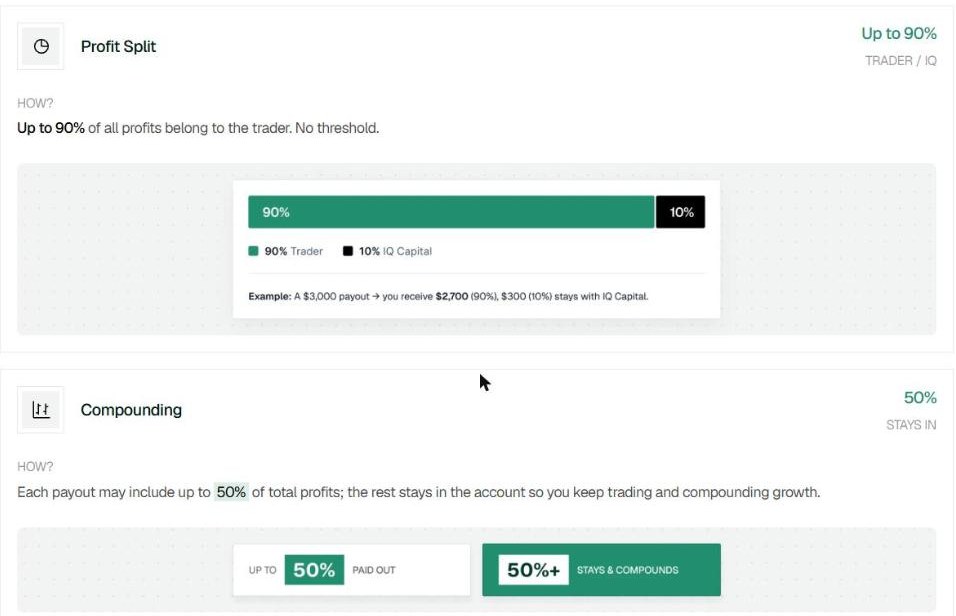
The split itself is at the top of the market. Up to 90% of all profits belong to the trader, with no threshold and no earn-first tiering applied to the split. IQ Capital publishes its own worked example: a 3,000 dollar payout pays the trader 2,700 dollars, with 300 dollars staying with the firm. On the Futures side the published example is a 2,000 dollar payout paying 1,800 dollars.
Stack the three rules together and the arithmetic for a first IQ Capital payout on a 50,000 account looks like this. Profits of 3,000 dollars; 50% of that is eligible, so 1,500 dollars; the per-request cap is also 1,500 dollars; the 90% split leaves 1,350 dollars in hand. The headline figure is 90%, and the cash figure on that first request is 45% of accumulated profit.
None of that is concealed and none of it is unusual for the category. It is simply three published rules that have to be read in the right order, and reading them in the wrong order is the most common reason a first payout feels smaller than expected.
Why half your profit stays in the account
The 50% that does not come out is not withheld by the firm in any adversarial sense. It remains in the funded account as tradeable capital, which is why IQ Capital files it under compounding rather than under restrictions. A trader who leaves it there is trading a larger balance on the next cycle, and the per-request cap for the next IQ Capital payout is higher as well.
The structure therefore rewards a long relationship and penalises a smash-and-grab. Whether that suits you depends on whether you want the firm as a funding source or as a one-off payday, and that is a question worth answering before buying an evaluation rather than after.
How fast an IQ Capital payout arrives
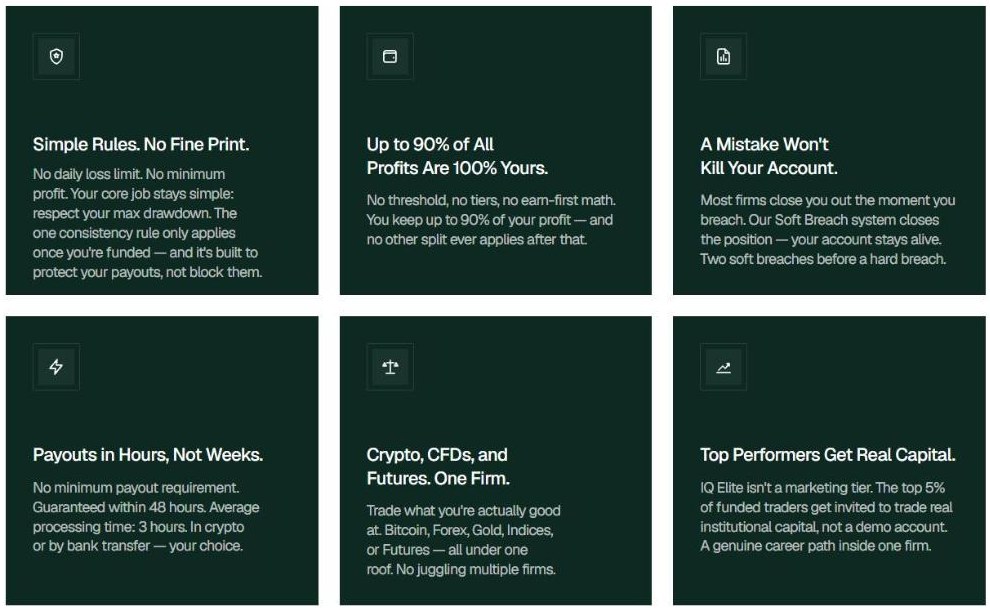
Speed is where IQ Capital markets hardest, and the published IQ Capital payout claims are specific enough to hold the firm to. The payout page states there is no minimum payout amount, that payment is guaranteed within 48 hours, and that average processing time is 3 hours, in crypto or by bank transfer at the trader’s choice.
A 48-hour guarantee with a stated three-hour average is a firmer commitment than the monthly cycles common elsewhere, and it is the single strongest selling point of the IQ Capital payout model. It is also, by its nature, the one claim a desk review cannot verify: processing time can only be confirmed by traders who have actually been paid, so weight recent payout-related reviews accordingly.
Note the distinction the firm is drawing. “No minimum payout requirement” refers to the amount — there is no floor you must reach before requesting. It does not remove the four eligibility conditions above, which are published separately and remain in force.
The fees that come out before your first IQ Capital payout
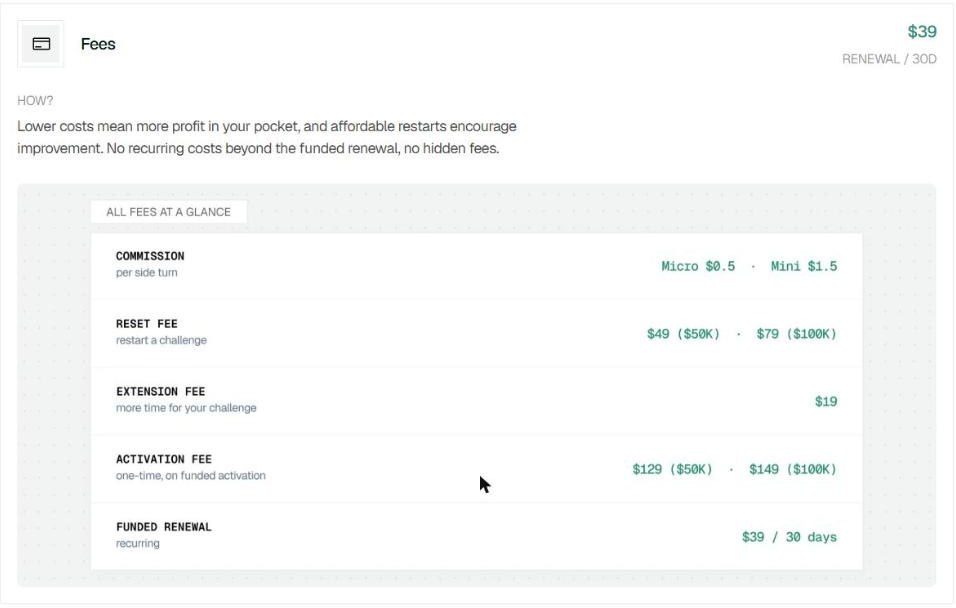
An IQ Capital payout article that ignores the cost side is only half the picture. IQ Capital publishes a complete fee list, and three of the five items land between you and your first IQ Capital payout.
| Fee | When it applies | Published amount |
| Commission | Per side turn | Micro 0.5 USD · Mini 1.5 USD |
| Reset fee | Restart a challenge | 49 USD (50K) · 79 USD (100K) |
| Extension fee | More time for your challenge | 19 USD |
| Activation fee | One-time, on funded activation | 129 USD (50K) · 149 USD (100K) |
| Funded renewal | Recurring | 39 USD / 30 days |
The activation fee is the one that surprises people, because it falls due after you pass rather than at checkout. The funded renewal is the one to model properly: at 39 dollars every 30 days it is a standing cost against a funded account, and a trader who needs 10 active trading days plus time to clear the consistency rule may well pay it once or twice before the first IQ Capital payout lands. The firm states there are no recurring costs beyond that renewal and no hidden fees.
Commissions matter here too, and not only as a cost. IQ Capital counts trading fees, commissions, spreads and slippage inside its max-position-loss calculation, and states that reaching the limit exactly already counts as a breach. Your per-trade risk has to clear the limit after costs, not before.
Breach logic: the fastest way to lose an IQ Capital payout
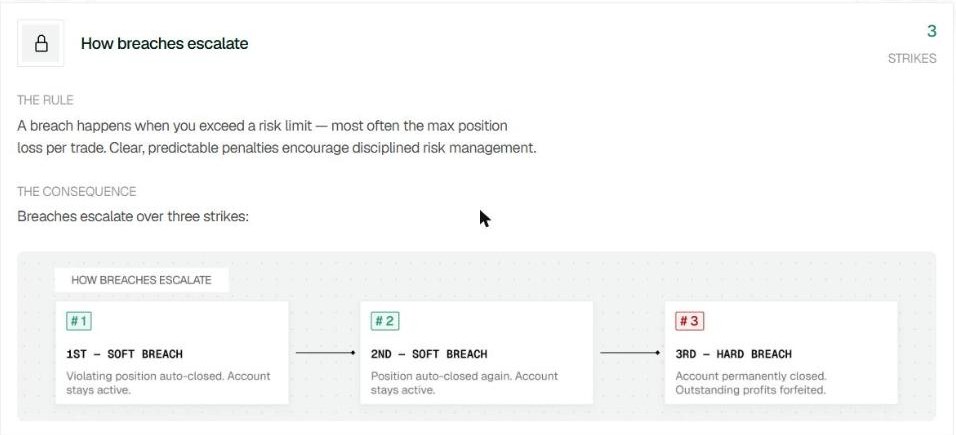
IQ Capital runs a three-strike system, and it is genuinely more forgiving than the single-breach-and-you-are-out model most firms use. A breach happens when you exceed a risk limit, most often the max position loss per trade.
The first soft breach auto-closes the violating position; the account stays active. The second soft breach does the same again; the account still stays active. The third is a hard breach: the account is permanently closed and outstanding profits are forfeited.
That last clause is the one to underline in any IQ Capital payout article. Profit sitting in a funded account is not yours until it has been through an IQ Capital payout request; a third strike erases it. Combined with the 50% rule — which guarantees that at least half your profit is always sitting unpaid in the account — this is the single largest risk to money you have already earned.
One more mechanic worth knowing, because it causes accidental breaches. Risk is counted per market: all positions in the same market count as one single trade against the max-position-loss limit, and each asset pair is its own market. Three entries on BTC/USDT are one position for risk purposes, not three.
Practices that can void an IQ Capital payout
Beyond risk limits, IQ Capital publishes a list of prohibited practices. Most are standard; a few have IQ Capital payout consequences that are worth reading before you trade rather than after.
Platform or market manipulation — spoofing, layering, deliberate manipulation of price feeds — results in immediate account termination. Latency arbitrage and exploiting execution delays are prohibited. Copy trading, mirror trading and external signal providers or bots are not allowed; third-party expert advisors and AI systems are conditional, permitted only where the trader has full access to the source code and demonstrable control, with black-box or commercial bots excluded. Account sharing and multiple or duplicate accounts are prohibited.
Two have a direct line to your money. Hedging — opposing positions in the same or correlated markets, including across multiple accounts — is prohibited during both the Evaluation and Qualified phases in Futures, except where explicitly enabled by the account’s trading conditions. And promo codes are single-use and non-transferable: the firm states that products with single-use restrictions may be excluded from payouts if misused across multiple profiles. A discount abused at checkout can therefore cost an IQ Capital payout months later.
IQ Capital also explains why the scalping rule exists, which is rarer than it should be. The firm states that it begins replicating successful traders early, so strategies must be realistically executable in live markets — and ultra-short holding times often are not. That is a clearer rationale than the usual anti-abuse language, and it tells you something real about how the business works.
Where the published IQ Capital payout numbers disagree
This review found several places where IQ Capital’s own pages state different things. All of them are published by the company; this article reports both sides rather than picking one, and readers should confirm the live figure before paying.
Daily loss limit. The payout page states there is no daily loss limit. The challenge pricing table lists a daily loss limit of 1,000 USD on the 50K and 1,500 USD on the 100K.
Tiering. The payout page says there are no tiers. The payout structure card publishes a per-request cap that is explicitly tiered by payout count.
Minimum holding time. The core rules publish a scalping rule with a 15-second hold threshold. The prohibited-practices section states there is no minimum holding-time requirement, and that the rule applies only when very short-term trading becomes a clear and recurring pattern contributing significantly to profits.
Minimum trading days. The rules page states there are no required minimum trading days in the Challenge and that you can pass in a single day. The pricing table lists a 30-day minimum.
Reset fee. The fee table lists 49 USD on the 50K and 79 USD on the 100K. The challenge comparison table lists 299 USD and 599 USD.
Ratings. The payout page shows 4.8 out of 5 from 200 or more reviews with 96% rated Excellent. Trustpilot, checked on 21 October 2026, shows 4.7 from 585 reviews, with 553 of them in the last twelve months, 89% at five stars and 4% at one star.
None of these is evidence of bad faith; a fast-moving product with several account families will produce exactly this kind of drift. But a trader budgeting around an IQ Capital payout should treat the rules page as the operative document and verify at checkout, because that is where the binding number appears.
Licensing, jurisdiction and where a payout dispute goes
IQ Capital publishes a full imprint: BEYOND IQ CAPITAL Ltd., Gros Islet, Saint Lucia, with Christoph Radecker named as managing director. What it does not publish is a financial licence, a regulator or a supervisory registration number, and this review found none.
There is a second wrinkle worth recording. Trustpilot lists the company’s contact location as the U.A.E., while the imprint on the company’s own site gives Saint Lucia. Both are published; this review does not attempt to reconcile them. Trustpilot also attaches a standing notice that the company may be associated with high-risk investments, and reports that the firm has replied to 20% of negative reviews and typically takes over a month to reply.
The practical consequence is concrete and should be said without softening: if an IQ Capital payout is refused or delayed, there is no financial regulator to appeal to. Your protection is the published rule set, the firm’s reputation and the review record — not a supervisory authority. For a neutral frame on how to check a firm before committing money, the US Commodity Futures Trading Commission runs a public registration check and explains what each status means, and the same questions apply to any firm that holds money you have earned.
Risk warning and restricted countries
Trading leveraged instruments involves substantial risk and may result in the loss of all allocated capital, which is IQ Capital’s own wording. The firm states plainly that no strategy, rule set or evaluation guarantees profitability, and that past performance, payouts and testimonials are not indicative of future results. Nothing in this article is investment advice.
Model your worst case as the total of the fees you have paid plus any unpaid profit sitting in a funded account, because a hard breach forfeits the latter. Every evaluation fee is at risk from the moment it is paid, and no part of the IQ Capital payout structure changes that.
On restricted countries, IQ Capital states only that services may not be available in all jurisdictions, and says it serves traders in 52 countries. This review found no published list of excluded jurisdictions. Absence of a list is not the same as availability: anyone in a jurisdiction with rules on prop-trading arrangements, or who may be caught by sanctions screening, should confirm eligibility before paying, since fees are not refundable.
Who the IQ Capital payout model fits
The IQ Capital payout model fits a trader who intends to stay. The caps rise with payout count, half of every profit compounds inside the account, and the fee structure rewards not resetting. Someone who plans to trade the same funded account for months extracts far more from this structure than someone looking for one large withdrawal.
It fits a trader who works to a daily number. Ten active trading days, a 30% consistency ceiling and a per-trade loss limit measured after costs all point the same way: many modest days beat a few big ones, and the rules are built to make that the only route to an IQ Capital payout. Start with the smallest IQ Capital account to learn the payout rules in practice before committing to a larger tier.
It fits less well if you scalp, if you run commercial bots or copy trading, or if you need a regulated counterparty and a formal dispute route. Those are explicit exclusions rather than grey areas. The published IQ Capital payout rules are worth reading end to end before you decide which description is yours.
How this IQ Capital payout review was done
This is a desk review. Every rule, figure and claim above was read from the public IQ Capital website — the general rules page, the payout page and the company imprint — in a browser on 21 October 2026, with no account created, no evaluation purchased and no trade placed. Trustpilot figures were read the same day from the public profile.
No performance claim is made or implied, and this review has no way to verify IQ Capital payout execution, which only paid traders can confirm. Where the company’s own pages disagree, both figures are reported side by side rather than averaged or resolved. Company statements on funded-trader counts, country coverage and total payouts are labelled as company claims because no independent verification exists. Screenshots are of published rule pages only; no named customer reviews and no account data appear in them.
Prop-firm rules and fees change without notice, so confirm anything that matters at the live IQ Capital checkout page before you pay.
The short version
The IQ Capital payout mechanism is one of the better-documented in the category. Four published eligibility conditions, a per-request cap table that grows with loyalty, a 90/10 split with the firm’s own worked examples, payment in USDC or USD, and a 48-hour guarantee with a stated three-hour average. A three-strike breach system that lets you survive two mistakes is a real advantage over the single-breach norm.
The costs to plan for are equally plain: 50% of profit stays in the account on every request, the first payout on a 50K account is capped at 1,500 dollars of eligible profit, there is an activation fee after you pass and a 39-dollar renewal every 30 days, a third breach forfeits unpaid profit, and there is no regulator standing behind any IQ Capital payout. Add the handful of places where the company’s own pages disagree, and the sensible approach is the same one the rules themselves encourage: start small, trade many modest days, and request your first IQ Capital payout as early as the ten-day condition allows.
Overall: 4.3 / 5


