
How this review was done. Funded Trader Markets is a proprietary trading firm selling evaluations, not a licensed broker, so there is no live account to fund and test. Everything below is a desk review built from FTM’s own published pages — the programs, the How It Works guide, the FAQ rule tables and the Terms and Conditions — read in October 2026. Where two FTM pages disagree, both figures are reported.

Most prop firms bury their rules. Funded Trader Markets does the opposite: the FAQ opens with “nothing hidden, every rule written down” and then prints the profit split, the drawdown percentages and the consistency rule in a table you can read before you pay anything. That alone makes it easier to review honestly than most of the field.
What Funded Trader Markets actually sells
This is the part to get straight before any of the numbers matter. In its own Terms, FTM states plainly that it “is not a broker, does not offer financial or investment advice, and does not facilitate trades in live markets”, and that “all accounts (Evaluation, Funded, and Instant Funded) operate in a simulated environment using virtual capital, and trades are not executed in real markets.” Profit rewards, it adds, are “performance-based rewards, not investment returns.”
So what you buy from Funded Trader Markets is an evaluation: a fee for the right to trade a simulated account under published rules, and a contractual promise that if you hit the targets without breaking the limits, FTM pays you a share of the simulated profit as a reward. That is the whole product. It is a skills contest with a cash prize, not a brokerage account, and reading it any other way is how people end up disappointed.
The three Funded Trader Markets programs
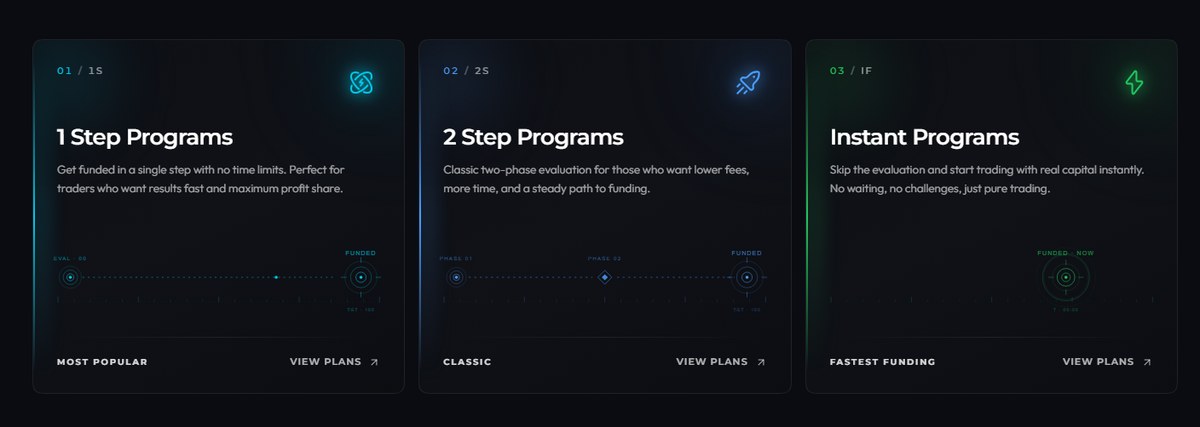
- 1-Step Challenge, from $24. One evaluation phase, no time limits. FTM marks it “most popular” and aims it at traders who want the fastest route and the largest profit share.
- 2-Step Challenge, from $33. The classic two-phase route, with no time limits, static drawdown and lower fees.
- Instant Funding, from $47. No evaluation at all — you start directly on a funded account.
One wording note worth flagging: the Programs page describes Instant Funding as trading “with real capital instantly”, while the How It Works page describes the same product as starting “directly with a simulated funded account”, and the Terms say every account type is simulated. Read the Terms as the governing text.
Across the 1-Step range, FTM says you can trade up to $800,000 of simulated capital in combined account size.
The 1-Step Nitro numbers, from FTM’s own rule table
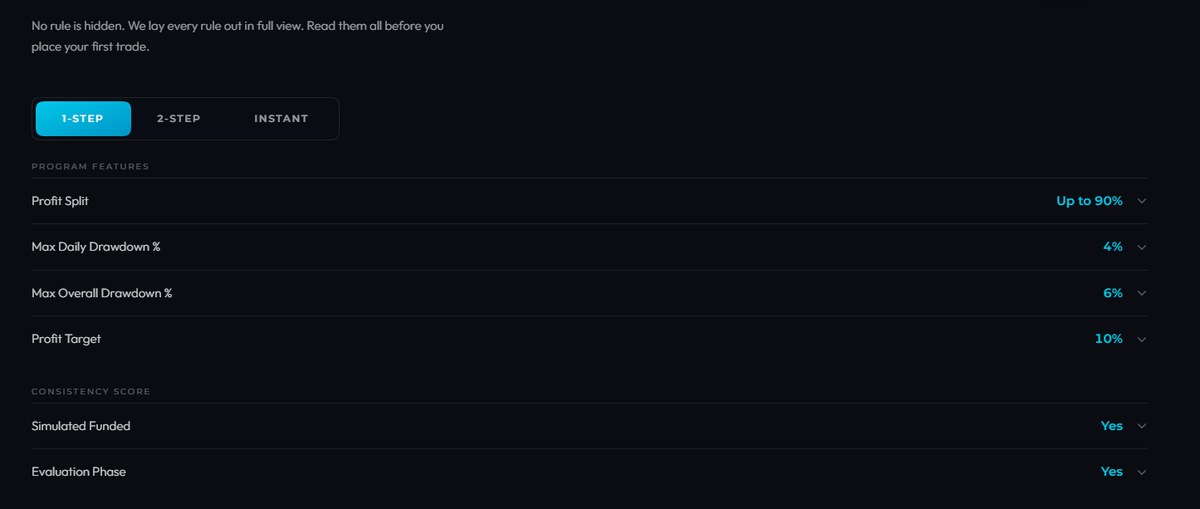
For the 1-Step Nitro account type, the published figures are:
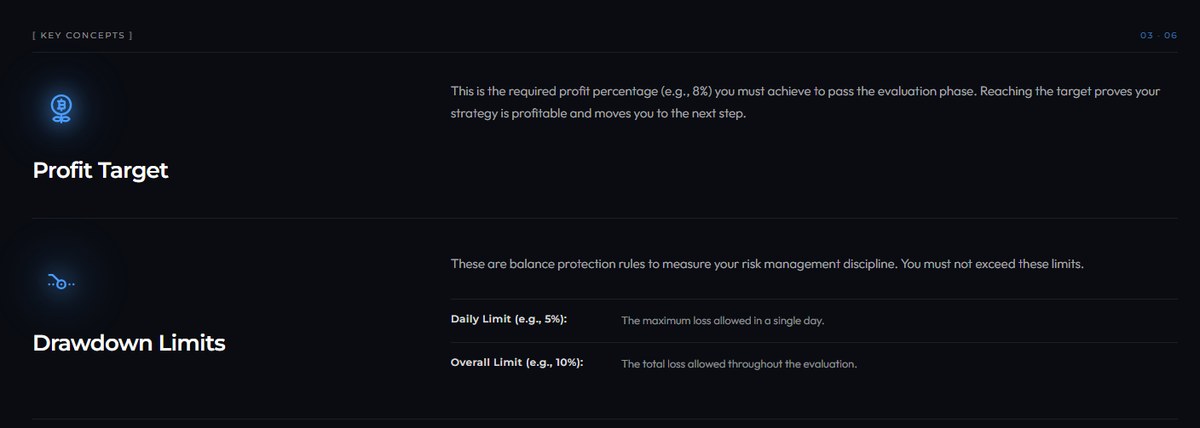
- Profit target: 10%. On a $100,000 account that is $10,000.
- Max daily drawdown: 4% of the initial balance — and it does not scale with profits.
- Max overall drawdown: 6%, trailing your highest balance until a milestone (below).
- Profit split: up to 90%.
The daily limit has a mechanic worth understanding before you trade it. Each day at 5PM EST, FTM takes the higher of your balance or equity and subtracts 4% of the initial balance to set that day’s stop-out. On a $100,000 account, if the higher figure at 5PM is $106,000, the stop-out becomes $102,000; touching that level on either balance or equity at any point is a breach. One exception: on the 300K Nitro account the daily limit is 3%, not 4%.
Funded Trader Markets also sells a second 1-Step variant, 1 Step Nitro X, which FTM describes as having the lowest profit target in the challenge phase, aimed at traders with strong risk management who want a minimal evaluation target.
How the trailing drawdown stops trailing
This is the single most useful rule Funded Trader Markets publishes, and most firms do not spell it out as clearly as Funded Trader Markets does.
The 6% overall limit trails your highest recorded balance. On a $100,000 account, if your balance reaches $103,000 the stop-out moves to $97,000 and stays there unless you set a new high. But once you have made 6% total profit, the overall drawdown locks to the initial balance — $100,000 — and stops moving with new highs.
The practical consequence: the first 6% is the dangerous stretch, because the floor is chasing you. Clear it and the profit you have already banked is protected by a fixed floor. Traders who understand that usually trade the first phase more conservatively and open up afterwards.
The consistency rule on funded accounts
On a simulated funded 1-Step Nitro account, Funded Trader Markets applies a consistency score: no single day’s profit may exceed 45% of your total profit. If one day breaches that threshold, you keep trading until your best day falls back below 45% of the total.
This is not a penalty so much as a pacing rule — it stops a single lucky session from converting into a reward. Both the evaluation phase and the simulated funded phase are marked “Yes” for consistency in FTM’s table, so plan for it from the first trade rather than discovering it at payout.
What Funded Trader Markets does not forbid
Most of a prop firm review is normally a list of banned behaviours. Here the interesting list runs the other way, and FTM publishes its reasoning for each one.
- No “toxic trading” or gambling rule. FTM’s position is that the term is too subjective to enforce fairly: “What one person considers gambling behavior, another considers a legitimate strategy.” Its argument is that the built-in drawdown limits already punish recklessness, so a vague behavioural rule adds doubt without adding safety.
- No lot size restrictions. Any size your margin and leverage permit is allowed, and changing position size between trades is explicitly not penalised.
- Martingale and layering allowed. Increasing size after a loss, or scaling into a position at several price levels, are both treated as legitimate position management.
For traders who have been failed by a discretionary “trading style” clause elsewhere, that written-down permissiveness is the strongest thing Funded Trader Markets has to offer. The limits that do exist are numeric and published, which means you can test a strategy against them before you pay.
FTM does retain two discretionary powers worth knowing: it may reduce your leverage to 1:10 if it judges your strategy too risky for its risk management, and it may request a verification call before issuing a funded account or releasing a reward.
Platforms, payment and KYC at Funded Trader Markets
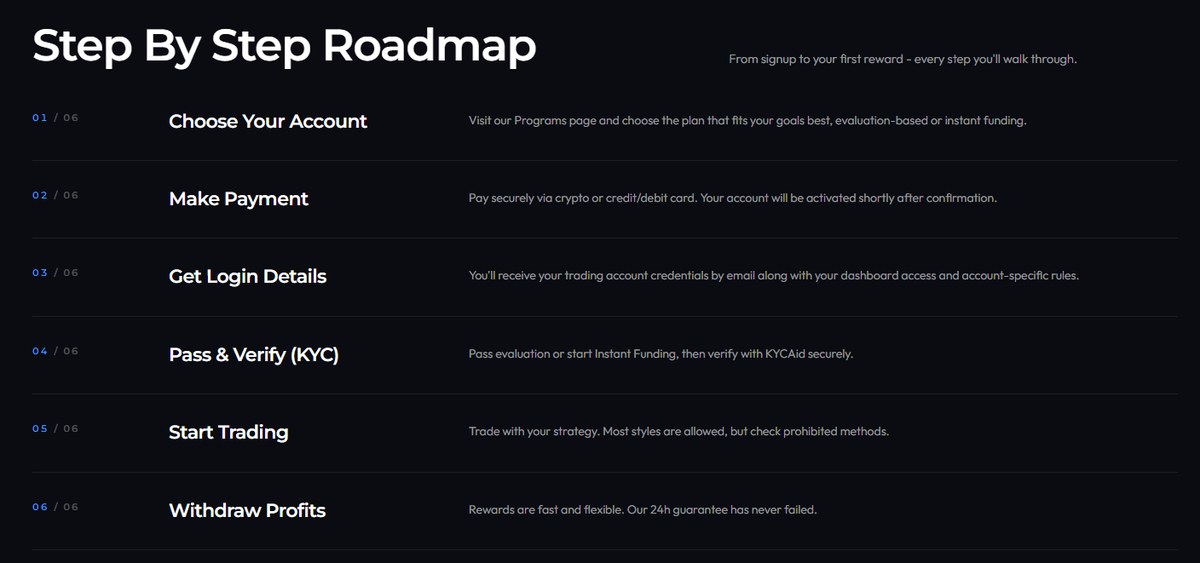
The route Funded Trader Markets publishes is six steps: choose a program, pay by crypto or credit/debit card, receive account credentials and dashboard access by email, pass the evaluation (or start Instant Funding) and verify identity through KYCAid, trade, then withdraw.
Funded Trader Markets runs on MetaTrader 5 and cTrader. The IP rules are stricter than most and are worth reading before you buy, because breaking them is an account problem rather than a warning:
- Your trading IP must not overlap with another user’s trading, dashboard or KYC IP.
- Purchases and KYC submissions made through a VPN or VPS are prohibited, and the country of the purchase IP must match the country of KYC.
- Trading through a VPN on the platform is allowed, provided the VPN IP is not in a restricted country. Dashboard access through VPN or VPS is not allowed.
- MT5 and cTrader do not accept US-origin IPs.
Funded Trader Markets rewards and the 24-hour claim
Funded Trader Markets advertises a 24-hour reward guarantee and states on its own roadmap that it “has never failed”, with an average processing time it puts under 20 minutes. Those are company-published figures and are not independently audited, so treat them as a service promise rather than a measured statistic — but the promise is at least specific enough to hold the firm to.
On the fee itself, the Terms are blunt: all sales are final and the company does not issue refunds. There are free reset opportunities on failed challenges in some circumstances, but the evaluation fee is not coming back.
Company information and registration status
Funded Trader Markets publishes its corporate structure in full, which is more than many firms in this sector do. Three entities are named:
- FTM Funded Trader Markets LTD — registered in Cyprus, company number HE462185, registered office at Alekou Konstantinou 56, Strovolos, 2024, Nicosia. This entity owns and operates the website.
- Funded Trader Markets LTD — incorporated in Saint Lucia, registration number 2025-00239, registered office at Ground Floor, The Sotheby Building, Rodney Village, Rodney Bay, Gros-Islet. This entity provides the simulated trading services.
- Formed Technologies INT FZCO — a UAE entity that processes payments; the Cyprus company acts as payment agent on its behalf depending on the processor chosen at checkout.
Risk warning
Funded Trader Markets publishes the following warning, reproduced here in full:
“Trading CFDs in a live environment of financial markets involves a substantial financial risk and may not be suitable for all individuals. In this case, you may incur substantial financial losses. For your best interests, it is best to consult with an independent financial advisor before making any financial decisions. Testimonials featured on this website are not indicative of future results as individual performance can vary. CFTC Rule 4.41 — Hypothetical or simulated performance results have certain limitations. Unlike an actual performance record, simulated results do not represent actual trading. Since the trades have not been executed, the results may have under- or over-compensated for the impact, if any, of certain market factors, including lack of liquidity. No representation is being made that any account will or is likely to achieve profit or losses similar to those depicted on this website.”
The rule FTM cites is a real one. You can read the text of 17 CFR 4.41 on the US eCFR and see exactly what the regulator requires firms to disclose when they present simulated results. It is a useful habit to apply to every prop firm you look at, not just this one.
The short version
Funded Trader Markets sells evaluations for simulated accounts from $24, across 1-Step, 2-Step and Instant Funding routes, with a published 10% target, 4% daily and 6% trailing overall drawdown on the 1-Step Nitro, a profit split of up to 90%, and a 45% consistency rule on funded accounts. Rules you would normally have to discover the hard way — lot sizing, martingale, position-management style — are explicitly permitted and the reasoning is published.
What it is not is a regulated broker, and the firm says so itself: every account is simulated, the rewards are performance payments rather than investment returns, and the fee is final. Read the restricted-jurisdiction list carefully, read the risk warning above in full, and treat the evaluation fee as the cost of entering a contest you may not win.


