
Almost every broker offers a demo account, and almost none of them make it worth taking seriously. The Weltrade demo account is a better-specified version of the idea: free to open, funded with $100,000 in virtual money, running on real live market data, and available on both MetaTrader 4 and MetaTrader 5. This 2026 guide covers exactly what you get, what it is genuinely good for, and how to open one in four steps.

What the Weltrade Demo Account Gives You
Weltrade frames it in one line: “Open a free demo account and explore financial markets using virtual funds. Learn how trading works, test strategies, and gain experience before trading with real money.” Four numbers sit behind that promise.
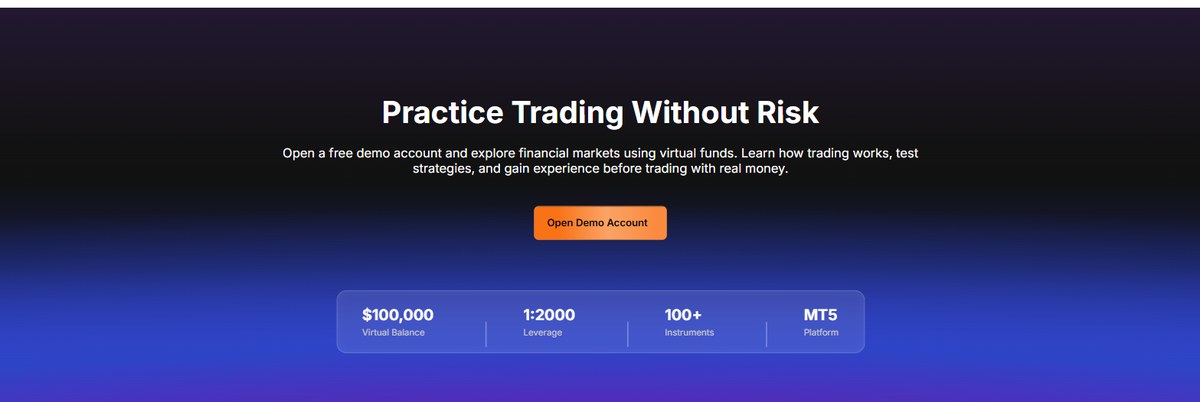
- $100,000 virtual balance
- 1:2000 leverage
- 100+ instruments
- MT5 as the headline platform (MT4 is also supported)
The virtual balance is the figure most worth pausing on, and not for the reason you might think — more on that below. Open a free Weltrade demo account and the whole set is available without funding anything.
Four Things a Demo Account Is Actually For
Weltrade calls it “the safest way to start trading” and breaks the use case into four jobs. They are worth taking at face value, because each one maps to a real mistake that costs beginners money.
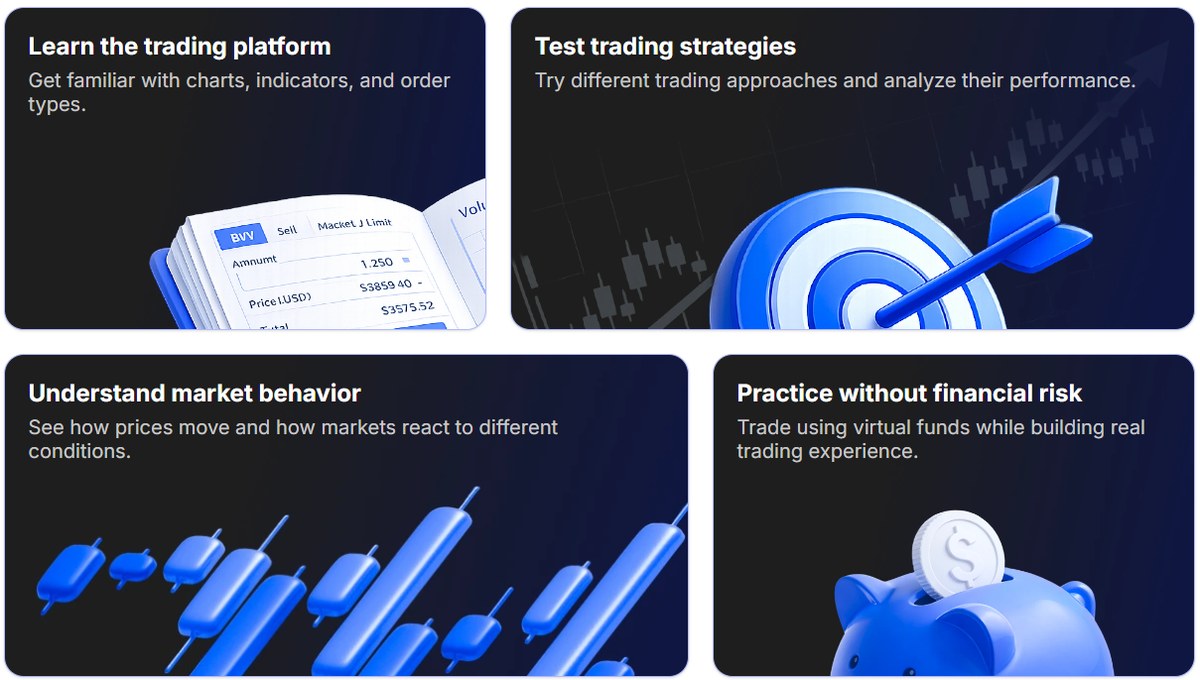
- Learn the trading platform — get familiar with charts, indicators and order types.
- Test trading strategies — try different approaches and analyse how they performed.
- Understand market behaviour — see how prices move and how markets react to different conditions.
- Practise without financial risk — trade with virtual funds while building real experience.
The first one is underrated. A surprising share of early losses are not bad analysis at all — they are a market order placed where a limit was intended, a stop set on the wrong side, or a position sized ten times larger than planned. Learning the platform’s mechanics with fake money is the cheapest lesson in trading.
Real Prices, Real Charts, Real Data
A demo is only useful if the market it simulates is the real one. Weltrade is explicit here: “Although demo accounts use virtual funds, market data remains real. You see live prices, current market charts, and real market movements, allowing you to practice trading strategies in conditions similar to live trading.”
That matters because a demo running on synthetic or delayed prices teaches you nothing transferable. Practising a breakout strategy on live spreads, live volatility and live news reactions produces results you can at least reason about. It is the difference between a flight simulator and a video game.
Demo Account vs Real Account: The Honest Comparison
Weltrade puts the two side by side rather than blurring the line, which is the right call.
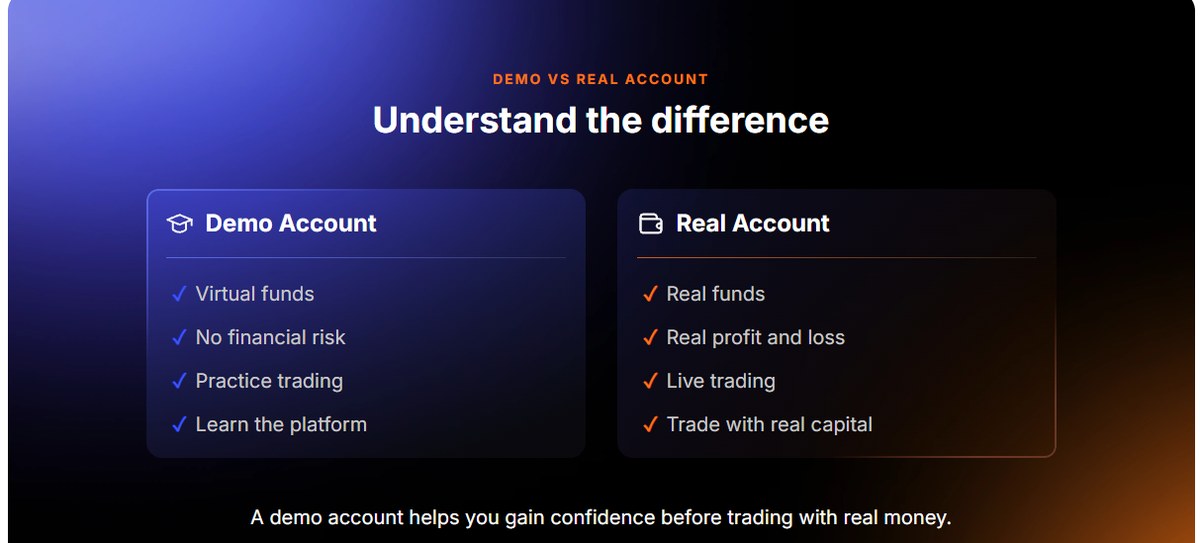
The demo gives you virtual funds, no financial risk, practice trading and platform familiarity. The real account gives you real funds, real profit and loss, live trading and real capital at work. The broker’s own summary line is measured: “A demo account helps you gain confidence before trading with real money.” Confidence — not a guarantee of results.
The One Thing a Demo Cannot Teach You
This deserves saying plainly, because no broker page will say it for you: a demo account cannot reproduce how it feels to lose money that is actually yours.
Every trader who has made the jump knows the gap. The strategy that ran calmly on virtual funds meets a real drawdown, and suddenly stops get moved, positions get doubled, and a plan that worked on paper falls apart. Demo trading builds skill and platform fluency; it does not build emotional discipline, because there is nothing at stake to be disciplined about.
The practical fix is to treat the demo as realistically as you can. Which brings us to the $100,000.
Why You Should Probably Not Trade the Full $100,000
The generous virtual balance is a genuine feature — it lets you test position sizing across a real portfolio and run multiple strategies at once. But it also carries a trap for beginners, and the fix is simple.
If you plan to start live with, say, $500, then practising with $100,000 teaches you nothing about position sizing at your actual scale. Risking 1% of a $100,000 demo is a $1,000 trade; risking 1% of your real $500 is $5. The habits are completely different.
So set your own limit. Decide what your live starting capital will realistically be, and trade the demo as if that were the balance. You keep the headroom for later, and every lesson you learn transfers directly. Compare Weltrade account types to see what your live account would actually look like.
Leverage of 1:2000 — Practise Restraint, Not Maximum Size
The demo carries the same 1:2000 ceiling Weltrade offers on its Micro, Cent, Pro and Raw Spread accounts. On a demo, it is tempting to find out what maximum leverage feels like. That is the one experiment worth skipping.
High leverage magnifies losses exactly as fast as it magnifies gains, and a habit built on a demo is the habit you will carry to a live account. Use the demo to discover what leverage level lets you sleep through a normal overnight move — that number is far more useful than the ceiling.
Practise on MetaTrader 4 or MetaTrader 5
The Weltrade demo account runs on both industry-standard terminals, so you can test which one suits you before committing.
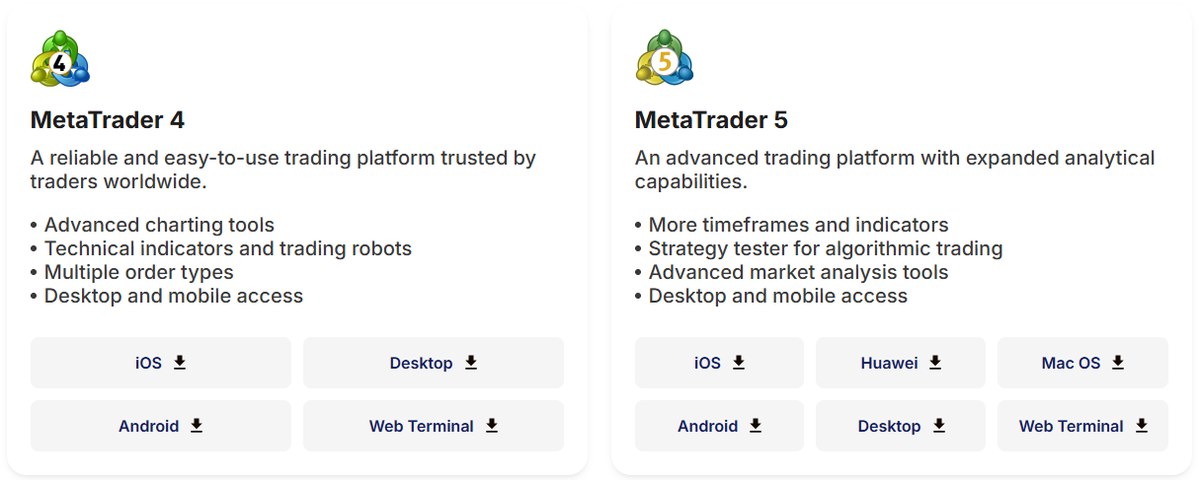
- MetaTrader 4 — advanced charting, technical indicators and trading robots, multiple order types, desktop and mobile. Available for iOS, Android, Desktop and Web Terminal.
- MetaTrader 5 — more timeframes and indicators, a strategy tester for algorithmic trading, advanced market analysis tools. Available for iOS, Android, Huawei, Desktop, Mac OS and Web Terminal.
MT5’s strategy tester is the reason to lean that way if you have any interest in automation — you can backtest an Expert Advisor against historical data and then forward-test it on the demo, all without a cent at risk. The Mac OS and Huawei builds also quietly solve a platform problem MT4 users have complained about for years.
How to Open a Weltrade Demo Account in Four Steps
There is no funding step and no payment details, which is the point.
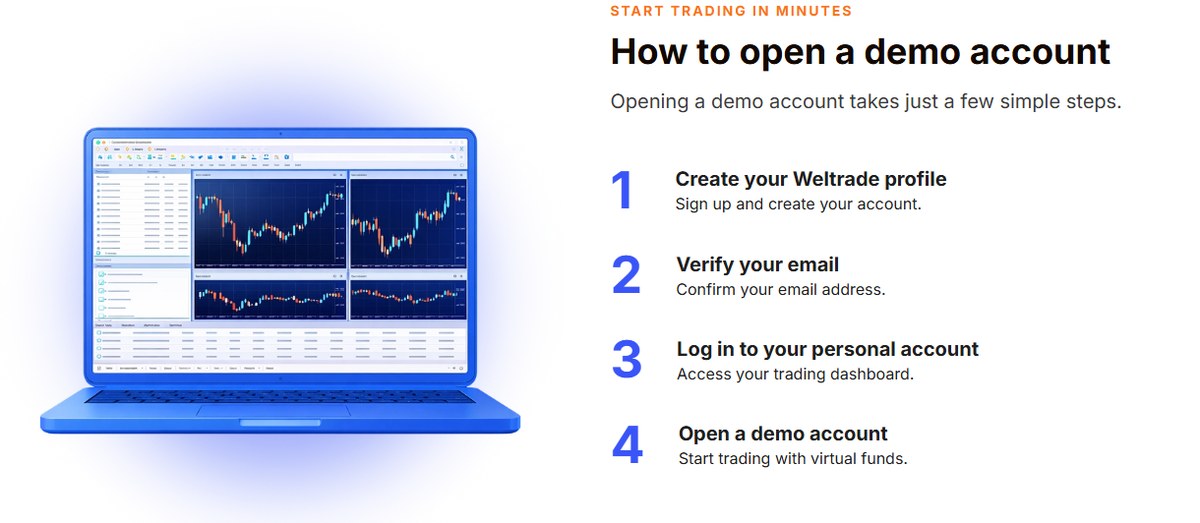
- Create your Weltrade profile — sign up and create your account.
- Verify your email — confirm your email address.
- Log in to your personal account — access your trading dashboard.
- Open a demo account — start trading with virtual funds.
Note that the profile you create is a full Weltrade profile, not a throwaway demo-only login — the same personal area later holds your live accounts. That is convenient, and it also means the usual advice applies: use a real email you control and a strong, unique password. Start with step one when you are ready.
A Practical Way to Use the Demo
A demo account used badly is just a game. Three habits make it count:
- Size it to your real capital, as described above, rather than to the virtual balance.
- Keep a journal — record why you entered, where the stop went and what happened. The record is the lesson, not the P&L.
- Give it a fixed duration — a month, or a set number of trades. An open-ended demo becomes a comfortable place to avoid ever going live.
And when you do move to a live account, start far smaller than the demo balance suggests you could. The first live months are for testing your temperament, not your strategy.
Who the Weltrade Demo Account Suits
It fits three groups cleanly. Complete beginners get a zero-cost way to learn the mechanics before any money is exposed. Traders switching brokers get to check Weltrade’s spreads, execution and instrument list against their existing setup without moving funds. And algorithmic traders get MT5’s strategy tester plus a live-data forward-testing environment in the same place.
The one group that gains less is experienced discretionary traders who already know MetaTrader well — for them the demo is a short broker-evaluation exercise rather than a training ground, and that is a perfectly good use of it too.
Regulation, Risk and Restricted Countries
Weltrade operates through several entities. Weltrade Ltd. is an International Business Company incorporated in Saint Lucia (Registration No. 2023-00055). Weltrade SA (PTY) Ltd is incorporated in the Republic of South Africa (Registration No. 2019/334947/07) and holds Financial Services Provider Intermediary Licence No. 50691, Category I — Intermediary Services in respect of Derivative Instruments, issued by the Financial Sector Conduct Authority, where the licence number can be verified. Danoa Enterprises LTD (Cyprus, Registration No. HE489250) acts as payment agent.
It is worth understanding what that structure means: the FSCA licence sits with the South African entity, while the principal trading entity is a Saint Lucia IBC — an offshore registration rather than a tier-1 retail regime such as the FCA, ASIC or CySEC, with no EU- or UK-style statutory compensation scheme behind it. None of this affects a demo account, which risks nothing, but it is the first thing to weigh before funding a live one.
Restricted jurisdictions. Weltrade states its services are not available to residents of the United States, Canada, the United Kingdom, European Union member states, the Russian Federation, Belarus, India, Iran and North Korea, nor to anyone subject to international (UN/US/EU/UK) sanctions or FATF restrictions, nor in any territory where such services are prohibited by local law.
Risk warning. In the company’s own words: CFDs are complex instruments and come with a high risk of losing money rapidly due to leverage. A substantial majority of retail traders lose money when trading CFDs. Consider whether you understand how CFDs work and whether you can afford to take the high risk of losing your money.
Final Verdict on the Weltrade Demo Account
As demo accounts go, this is a well-specified one: free, genuinely unlimited in ambition at $100,000 virtual, running on real live market data, and available on both MetaTrader terminals including MT5’s strategy tester. Four steps and no payment details stand between you and using it.
Its value depends almost entirely on how you use it. Trade it at your real intended size, journal the results, give yourself a deadline, and it will teach you most of what a beginner needs to learn before risking capital. Trade the full virtual balance at maximum leverage and it will teach you habits you cannot afford. The tool is good; open one free and the discipline is the part you bring.


