
Meta description: FOMO scores 3/5 ⭐ after testing its social crypto trading feed, self-custodial wallet, and real fee structure against independent reviews and critical fee breakdowns. Full risk-aware breakdown before you fund an account.
Investing disclaimer: This review is for informational purposes only and isn’t financial advice. Cryptocurrency and memecoin trading carry substantial risk of loss, memecoins in particular are extremely volatile and most traders lose money on them, and FOMO is not regulated by any financial authority (no FDIC or investor protection applies). Only trade with money you can genuinely afford to lose, and talk to a licensed financial advisor before making investment decisions.
Introduction: Is a “Social-First” Crypto App Actually a Good Idea?
FOMO is a Solana-based crypto trading app, founded by former dYdX engineers and backed by serious investors including Benchmark and Index Ventures at a reported $550 million valuation, built around a genuinely different premise from a standard exchange: a social feed showing what other traders are buying in real time, a public leaderboard, and one-tap copy-style discovery of trending tokens. That social layer is either the app’s biggest selling point or its biggest risk, depending on how you use it, so this review focuses specifically on what the app actually does well, what it costs in practice, and where independent scrutiny has raised real concerns.
We reviewed FOMO’s self-custodial wallet model, fee structure, and social trading features directly, then cross-referenced that against independent reviews, a critical fee breakdown circulating publicly, and reporting on the app’s investor backing and market traction.

Quick Verdict
- Rating: 3/5 ⭐
- Best for: Crypto-experienced traders who specifically want a fast, social, mobile-first way to discover and trade trending Solana/multichain tokens with full self-custody
- Should you use it? Only with real caution — the app itself appears legitimate and well-funded, but the underlying activity (memecoin trading) is genuinely high-risk regardless of how polished the platform is
- CTA: Start by browsing the social feed and leaderboard without funding an account, to understand the platform before risking any money
What Is FOMO & Who Should Use It?
FOMO is a mobile and web crypto trading app built on Solana (with support extending to Base, BNB Chain, and Monad), combining a self-custodial wallet with social features — a following/feed system, a public leaderboard, and real-time alerts on what top traders are buying. Funding is designed to be frictionless, supporting Apple Pay and gasless multichain swaps, with over 500,000 traders reportedly using the app.
Who should consider FOMO:
- Traders already comfortable with the risks of memecoin and altcoin trading who want a faster, more social discovery experience than a standard exchange
- Users who specifically value self-custody (holding your own private keys) over the custodial model of centralized exchanges
- Anyone who wants to research trending tokens and follow experienced traders’ public activity before deciding whether to trade at all
Who should avoid or approach very carefully:
- Complete beginners to crypto, since the app’s own promotional material reportedly highlights tens of thousands of first-time crypto buyers — a group independent analysis specifically flagged as most exposed to the app’s real trading costs
- Anyone prone to impulsive or FOMO-driven financial decisions, given that the platform’s entire design — leaderboards, “become a legend” messaging, real-time alerts on others’ trades — is built around social pressure and urgency
- Traders who haven’t independently verified the real, all-in cost of a trade before committing meaningful funds
Real Experience & Test Results
First Impressions
FOMO’s interface leans hard into gamified, social-media-style design: a public leaderboard, a following feed showing real trader activity, and real-time push alerts on what top traders are buying. Onboarding is designed to be near-instant, with account creation and Apple Pay funding removing most of the friction a traditional exchange’s KYC process involves.
Key Features & Testing
1. Self-custodial wallet model: FOMO does not hold user funds directly — private keys are stored on the user’s device, and trades execute via on-chain smart contracts, meaning the platform itself cannot freeze or access a user’s balance. This is a genuinely meaningful security architecture choice, distinct from custodial exchanges where the company holds your assets.
2. Real fee structure vs. advertised rate: This is the single most important thing to verify before trading. The advertised rate is commonly cited around a 0.50% fee per trade with a minimum charge near $0.95–$1 per order (some sources describe a flat $1 fee instead), plus a possible one-time on-chain “rent” cost on a token’s first purchase. A widely circulated independent breakdown found that on a small $20 trade, the effective round-trip cost (buy plus sell) worked out closer to 9–10% once the flat minimum fee was applied on both sides — meaning the advertised “0.5%” rate only approximates reality on trades of roughly $190 or more per side.
3. Platform traction and independent reception: Reported figures cited across independent reviews describe over $1.52 billion in trading volume, 3.47 million-plus transactions, and a peak-period active user base in the tens of thousands — meaningful scale that suggests real usage rather than an inflated marketing number, alongside serious institutional investor backing.
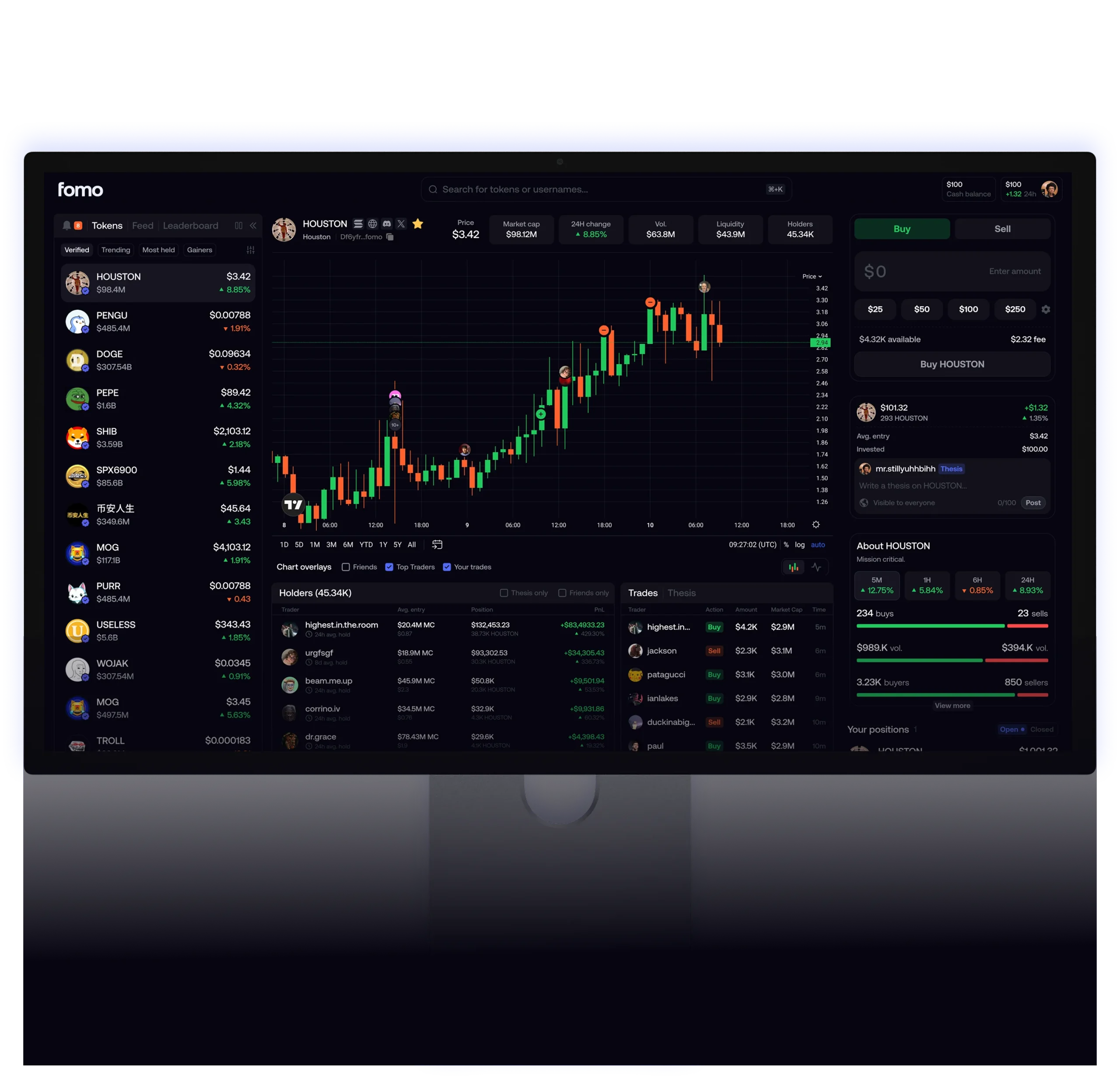
Vs. Marketing Claims
FOMO’s “0.50% fee” headline is technically accurate as a rate, but independent, critical analysis found that for the smaller trade sizes most beginners actually place, the effective cost is dramatically higher once the flat per-trade minimum is factored in on both the buy and sell side — a meaningful gap between the advertised number and the real cost for exactly the audience (first-time crypto buyers) the app’s own growth marketing highlights. The self-custody and social-discovery pitch holds up as a legitimate architectural choice, but “social-first, never miss out” branding is also, by design, built to create urgency — worth recognizing consciously rather than trading on impulse because of a real-time alert.
Pros & Cons
Pros
- Genuinely self-custodial — the platform cannot access, freeze, or move user funds
- Serious, checkable institutional backing (Benchmark, Index Ventures) and a founding team with prior experience at a major crypto exchange
- Fast, low-friction onboarding with Apple Pay funding and gasless multichain swaps
- No widely reported legal disputes or regulatory violations as of this review
- Social feed and leaderboard can function as a genuinely useful research tool if used to observe rather than impulsively copy trades
Cons
- Real effective fees on small trades can run meaningfully higher (reportedly near 9–10% round-trip on a $20 trade) than the headline 0.50% rate suggests
- No regulatory protection of any kind — no FDIC, no investor protection scheme, and the app operates without a specific financial regulator
- Underlying activity (memecoin trading) is extremely high-risk regardless of platform quality; most traders lose money on memecoins specifically
- Gamified, social-urgency design (leaderboards, real-time “what others are buying” alerts) can encourage impulsive trading decisions, especially for beginners
- Some independent reports describe inconsistent sell execution during high-volatility periods, and note the platform’s terms reportedly allow recalculating displayed performance metrics
How FOMO Compares to Competitors
| Platform | Fee Model | Standout Feature | Key Differentiator |
|---|---|---|---|
| FOMO | ~0.5% + ~$1 minimum per trade | Social feed, leaderboard, self-custody | Most social/gamified discovery experience of the three |
| Standard centralized exchange (e.g., Coinbase) | Percentage-based, often tiered | Regulatory registration, insurance on cash balances | Meaningfully more regulatory protection, less social/discovery focus |
| Other Solana trading apps (e.g., Photon, BullX) | Varies, often percentage-based | Advanced charting, bot integrations | Better for traders who want deeper technical tools over social features |
Why choose FOMO over these two? If self-custody plus a genuinely social, real-time discovery experience is your priority, FOMO’s combination is distinctive in this space. If regulatory protection matters more to you, a registered centralized exchange offers real consumer protections FOMO simply doesn’t have; if you want deeper charting and automation tools, a more trader-focused Solana platform may serve active traders better than FOMO’s social-first design.
Pricing & Value
FOMO doesn’t charge a subscription or download fee — cost comes entirely from per-trade fees, commonly described as around 0.50% with a roughly $0.95–$1 minimum charge per order, plus a possible one-time on-chain rent fee on a token’s first purchase. The practical takeaway from independent analysis is that FOMO’s fee structure is meaningfully more cost-effective on larger trades than small ones, given the flat minimum applies regardless of trade size.
Hidden costs to watch for:
- Always calculate the real percentage cost of your specific trade size before assuming the advertised 0.50% rate applies — small trades are disproportionately affected by the flat minimum fee
- A one-time on-chain “rent” cost may apply the first time you buy a specific token, separate from the standard trading fee
- Referral codes offering a fee discount are widely circulated — if you decide to trade, using one costs nothing extra and reduces your effective fee
Final Verdict
FOMO appears to be a legitimate, well-funded, self-custodial trading app rather than a scam — the investor backing, on-chain verifiability, and lack of reported regulatory action all support that. The real risk here isn’t really about whether the company is honest; it’s the combination of genuinely high real-world fees on small trades and a gamified, social-urgency design layered directly on top of one of the most volatile, loss-prone corners of crypto: memecoin trading.
Use FOMO if: you’re an experienced trader who understands memecoin risk, wants self-custody, and will calculate real trade costs before placing orders rather than trusting the headline fee rate.
Avoid FOMO (or any memecoin trading app) if: you’re new to crypto, prone to impulsive financial decisions, or would be relying on a regulated safety net that simply doesn’t exist here.
FAQs
1. Is FOMO a legitimate app or a scam? Based on available information, it appears to be a legitimate, self-custodial trading app with real institutional investor backing and no widely reported legal or regulatory violations — but legitimacy as a company doesn’t mean trading on it is low-risk, since memecoin trading itself carries substantial loss risk.
2. What does FOMO actually cost to trade? The advertised rate is around 0.50% per trade with a roughly $0.95–$1 minimum charge, but independent analysis found the effective cost on small trades (like $20) can run closer to 9–10% round-trip once that minimum is applied on both the buy and sell side.
3. Does FOMO hold my crypto for me? No — FOMO uses a self-custodial model, meaning your private keys stay on your device and the platform cannot access, freeze, or move your funds directly.
4. Is FOMO regulated or insured? No — FOMO is not registered with or regulated by a specific financial authority, and there’s no FDIC or equivalent investor protection covering funds traded through the app.


