
Binary options and CFD trading platforms have multiplied over the past decade, and few names come up as often in online trading forums as PO Trade (po.trade), the platform closely associated with the brand “Pocket Option.” Marketed as a fast, beginner-friendly way to trade forex, stocks, crypto, and other instruments, PO Trade has built a large international user base — but it has also attracted serious regulatory scrutiny. This review takes an evenhanded look at what the platform offers, what real users say about it, and the risks that any prospective trader should weigh before depositing money.
What Is PO Trade?
PO Trade is an offshore online trading platform that was reportedly founded in 2017 by a team of IT and fintech specialists with the stated goal of building an accessible, technology-driven trading experience. The platform is closely tied to several interconnected offshore corporate entities, and it operates under the broader “Pocket Option” brand, which is commonly described as being run by Gembell Limited, a company registered in the Marshall Islands.
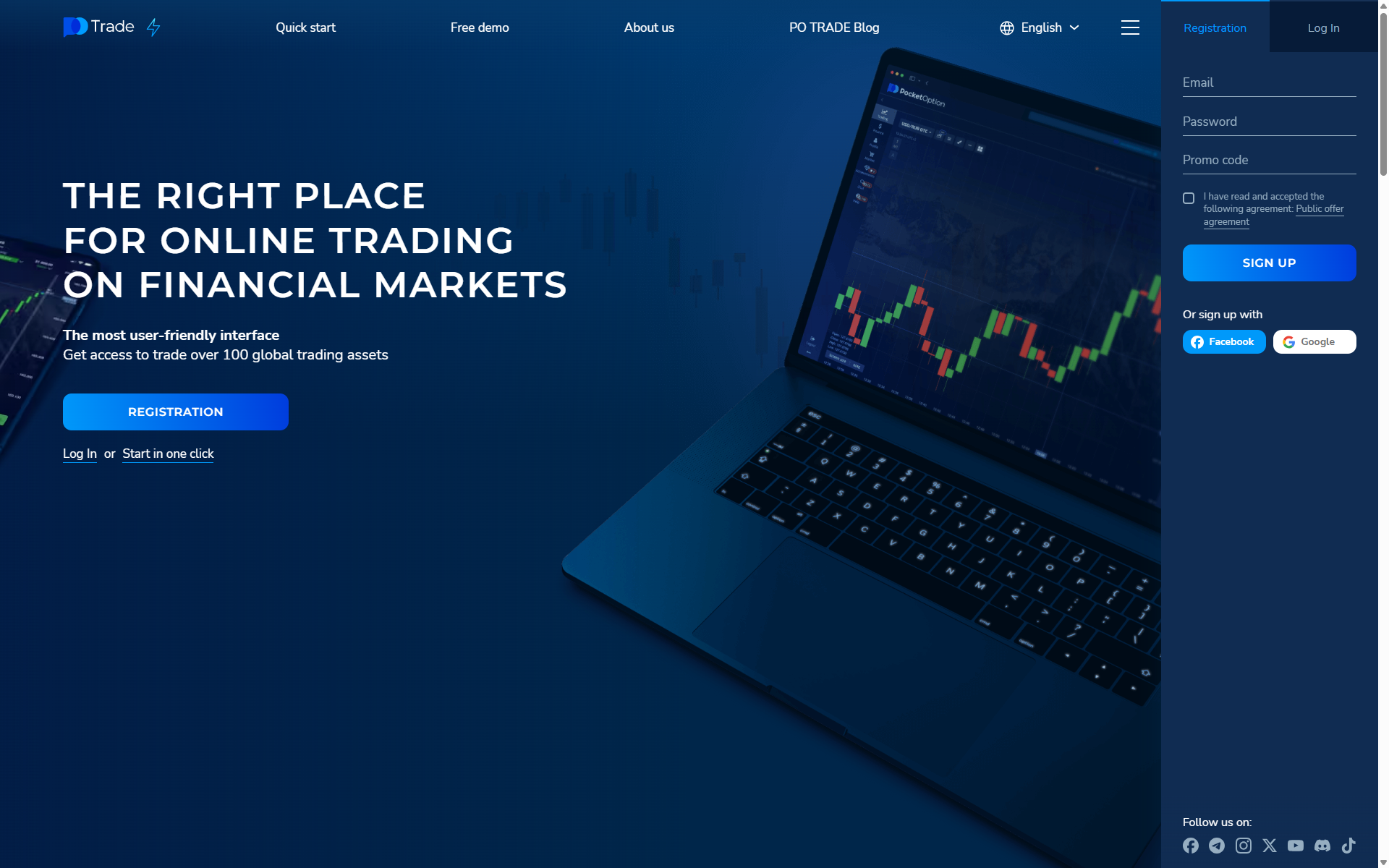
The platform’s own marketing describes itself as being “designed to ensure a smooth and comfortable trading experience for traders of all levels,” offering “complete freedom of choice, with numerous instruments, multiple trading modes, and versatile financing opportunities.” According to the site, users get access to more than 100 tradable assets across three different trading modes, each with a demo account option meant to ease the transition from practice trading to live trading.
On paper, this positions PO Trade as a one-stop shop for retail traders who want quick access to forex pairs, cryptocurrencies, stocks, and commodities without going through the account-opening hurdles typical of traditional, heavily regulated brokers.
Core Features
Range of assets. PO Trade advertises access to over 100 financial instruments, spanning forex, cryptocurrency, stocks, and commodities, which allows for a reasonable degree of portfolio diversification within a single account.
Multiple trading modes. The platform offers several trading modes — commonly cited as Quick Trading, Shares Trading, and MT4/MT5-style forex trading — each designed for a different trading style, from short-term binary-style trades to more traditional position trading.
Demo accounts. Each trading mode reportedly comes with its own demo account, letting new users practice with virtual funds before committing real money. This is a genuinely useful onboarding feature, especially for traders unfamiliar with binary options mechanics.
Low barriers to entry. Reviews consistently mention a low minimum deposit, a simple and fast registration process, and account verification that (for many users) is quick and straightforward. The interface itself is frequently praised as clean, intuitive, and mobile-friendly, with responsive charts and a range of built-in technical indicators.
High payout percentages. A recurring theme in positive user feedback is the platform’s high payout rates on popular currency pairs, which some reviewers report reaching up to roughly 92% on winning trades — a figure that is attractive relative to many competing binary options platforms.
Social/copy trading. Some independent reviews note that PO Trade supports a form of social trading, allowing less experienced users to copy the trades of more successful traders on the platform, along with multiple payment methods and a mobile app for trading on the go.
What Users Are Saying
User sentiment on PO Trade is sharply divided, and that split is itself one of the most important things to understand before signing up.
On the positive side, many reviewers describe an experience that feels fast, professional, and rewarding. Comments on the platform’s own review pages and third-party sites describe smooth deposits, quick trade execution, accurate charting, and support staff who respond quickly to questions. Several users specifically praise how easy the onboarding process is, noting that identity verification using government-issued documents was approved quickly. Some traders describe substantial short-term gains — for example, users reporting profits of several hundred dollars within 30 minutes using an “AI trade” feature, or turning a few hundred dollars into over a thousand within a week.
On the negative side, independent review aggregators tell a very different story. Sitejabber currently shows an average rating of roughly 1.9 out of 5 stars across 16 reviews for po.trade, which it characterizes as indicating that most reviewing customers were generally dissatisfied. A recurring complaint pattern across multiple platforms looks like this: the account and interface work fine during the deposit phase, trades execute normally, and the experience feels legitimate — right up until the user tries to withdraw funds. At that point, several users report their accounts being frozen, verification requests that never seem to resolve, and vague references to alleged violations of the platform’s “Public Offer Agreement” used as justification for withholding funds. One user described losing access to around $35,000 in accumulated profit this way, while another described weeks of unexplained account freezes after initiating a withdrawal.
It’s also worth noting a pattern common to many complaint threads about PO Trade and Pocket Option: reviews (including some replies purportedly from the company) sometimes point users toward third-party “fund recovery” services to resolve withdrawal disputes. Prospective traders should treat these recommendations with real caution, since fund-recovery services advertised in review comment sections are frequently themselves unverified or fraudulent operations that prey on people who have already lost money.
Trustpilot data reflects a similarly mixed picture: alongside enthusiastic five-star reviews praising ease of use and fast withdrawals, there are reviews describing the platform as feeling “like a trap designed to take both your investment and your profits,” with the reviewer stating they lost both their original investment and their earnings. Trustpilot itself cautions that anyone can post a review and that reviewers retain the ability to edit or delete their reviews at any time, which is a useful reminder to weigh review volume and patterns rather than any single testimonial — positive or negative.
Regulatory Status: The Biggest Red Flag
This is the section that matters most for anyone considering PO Trade, because it directly affects how much protection you have if something goes wrong.
PO Trade operates as an offshore platform without regulation from any tier-1 financial authority. It has not secured licensing from bodies like the U.S. Securities and Exchange Commission (SEC), the UK’s Financial Conduct Authority (FCA), or similarly rigorous regulators. Instead, the platform has historically claimed oversight from lower-tier entities such as the International Financial Market Relations Regulation Center (IFMRRC) and the Mwali International Services Authority (MISA) in Comoros — and reporting indicates that the MISA license tied to an associated entity was actually suspended in mid-2023.
Multiple major regulators have issued explicit warnings or enforcement actions concerning the Pocket Option / PO Trade ecosystem:
- The UK Financial Conduct Authority (FCA) issued a warning stating the firm is not authorized or registered to operate in the UK and may be targeting UK residents without permission.
- The U.S. Commodity Futures Trading Commission (CFTC) added Pocketoption to its Registration Deficient (RED) List in 2022, a list specifically maintained to flag foreign entities that appear to be soliciting U.S. customers without being properly registered to offer products within the CFTC’s jurisdiction.
- Belgium’s Financial Services and Markets Authority (FSMA) has flagged the platform over unlicensed operations and the absence of investor safeguards.
- France’s Autorité des Marchés Financiers (AMF) included the platform on a list of unauthorized forex brokers as far back as 2018.
- Canada’s Alberta Securities Commission has listed it on an investment caution list.
What this regulatory picture means in practice is significant. Tier-1 regulators typically require licensed brokers to keep client funds in segregated accounts, participate in investor compensation schemes, submit to independent audits, and provide a formal dispute-resolution path if a client and broker disagree about an account issue. PO Trade claims to maintain segregated client accounts, but — because it isn’t subject to tier-1 oversight — that claim has not been independently verified by any third-party audit. If the company were to face financial trouble, or if a dispute over a large withdrawal arose, users would have essentially no institutional recourse comparable to what exists with a regulated broker.
This doesn’t automatically mean the platform is fraudulent — offshore, lightly regulated brokers are common in the binary options space, and many users do trade and withdraw without incident. But it does mean the burden of trust falls entirely on the platform’s own conduct, with none of the structural protections that regulation is designed to provide.
Binary Options: A Structural Risk Worth Understanding
Beyond company-specific concerns, it’s worth remembering that binary options as a product category carry structural risks that regulators in the U.S. and EU have flagged repeatedly. The CFTC and SEC have jointly warned that much of the binary options market operates through internet-based platforms that may not comply with applicable regulatory requirements, and that complaints about these platforms often involve refusal to credit winning trades, denial of withdrawal requests, and, in some documented cases, manipulation of trading software to generate losing outcomes for the client. Binary options in general are restricted or banned for retail investors in a number of jurisdictions specifically because of this risk profile — a fact that applies to the product category broadly, not to PO Trade alone.
Pros and Cons Summary
Potential advantages:
- Wide range of tradable assets (100+ instruments across forex, crypto, stocks)
- Multiple trading modes with demo account options for practice
- Low minimum deposit and fast account registration
- Clean, mobile-friendly interface with responsive charting tools
- High advertised payout rates on major currency pairs
- Social/copy-trading features for less experienced users
Significant drawbacks:
- No tier-1 regulatory oversight (no SEC, FCA, ASIC, or equivalent license)
- Formal warnings issued by the FCA, CFTC (RED List), FSMA, and AMF
- Numerous user reports of frozen accounts and withdrawal delays, especially after large profits
- Unverified claims about segregated client funds
- Binary options as a product carry documented, industry-wide fraud risk
- Sharply polarized review base, with a low aggregate score on independent review sites like Sitejabber
Bottom Line
PO Trade delivers a genuinely slick and accessible front-end trading experience — fast onboarding, a wide asset selection, attractive payout percentages, and an interface that many users find easy to navigate. For traders using small amounts of discretionary, high-risk capital purely for short-term speculation, some do report smooth deposit-to-withdrawal cycles.
However, the platform’s lack of tier-1 regulation, combined with formal warnings from major regulators and a consistent pattern of withdrawal-related complaints — particularly once account balances grow — are not minor details. They represent exactly the kind of structural risk that regulatory oversight exists to mitigate. Anyone considering PO Trade should treat it the way seasoned traders treat any offshore, lightly regulated broker: start with the smallest possible deposit, use the demo account extensively first, avoid depositing money you cannot afford to lose entirely, and be skeptical of “guaranteed” or unusually high short-term returns advertised in testimonials. Before committing real funds to PO Trade or any similar platform, it’s worth checking current regulator warning lists (FCA, CFTC, AMF, FSMA) directly, since these lists are updated over time and a platform’s status can change.


