
Most reviews of this platform ask how fast it trades. This one asks a different question: what happens to your capital in the hours, days and weeks when you are not trading at all. That is where Axiom staking sits, and it is the part of the product that a 2025 feature tour never covered.
Axiom staking at a glance
- Two separate yield routes. Native SOL staking through Axiom’s own validator, and a lending yield the company advertises through its partner Marginfi. They are not the same product and the site does not combine their numbers.
- Direct validator staking: 0% commission, so the staker keeps 100% of inflation and MEV rewards.
- Liquid route: axiSOL, a liquid staking token managed by Solana’s Stake Pool Program, which Axiom describes as securing over 400,000 SOL.
- axiSOL costs: a 5% fee on earnings and a 0.1% fee on withdrawals.
- Advertised lending yield: up to 15% APY with instant withdrawals, company-stated, via Marginfi.
- Funding: up to $500 of crypto per week through a Coinbase integration, with no KYC.
- Custody: non-custodial, keys managed on Turnkey infrastructure. Axiom states it does not hold copies of your keys.
- Operator: Axiom Innovations Inc., funded by Y Combinator. No financial services licence.
How this review was done
Everything below is read from Axiom’s own published material in October 2026 — the product site, the documentation at docs.axiom.trade and the Terms of Use dated 26 February 2026 — and from the FCA’s published guidance on crypto investments. We did not open a funded account, and no figure here is a result we measured. Where Axiom states a number, we say that Axiom states it.
That matters more than usual with this product. A yield figure is a forecast, not a fact, and the only honest way to report one is to name who is forecasting it.
Two different yields, and they are not the same product
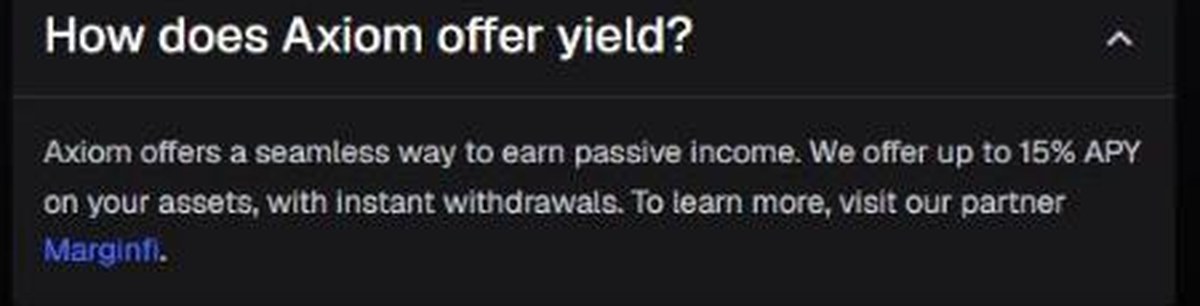
Read Axiom’s front page and you are told the platform offers “up to 15% APY on your assets, with instant withdrawals”, powered by Marginfi. Read the documentation and you are told something else: that you can “natively stake SOL with Axiom’s high performance validator”, with the rewards that come from Solana inflation and MEV.
These are two different mechanisms. One is lending into a money market, where the rate floats with borrower demand and the risk is the protocol’s. The other is proof-of-stake validation, where the rate comes from the chain itself and the risk is validator performance and lock-up. Axiom publishes both and, to its credit, does not merge them into a single headline number. We are recording both sources as they stand rather than averaging them, and a reader who wants the 15% figure should treat it as the ceiling of a lending rate, not as what Axiom staking pays.
The 0% commission route: staking straight to the validator
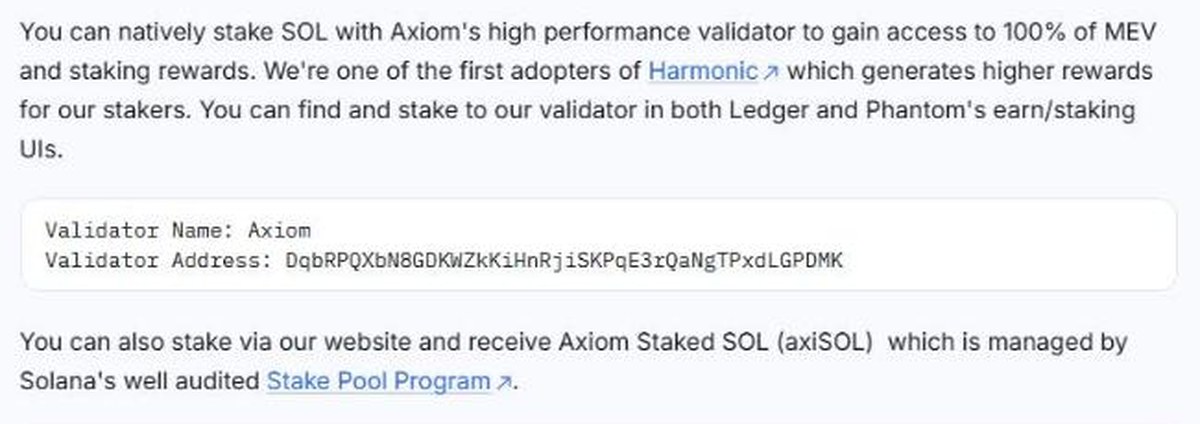
The cleanest version of Axiom staking is also the cheapest. Axiom runs its own Solana validator and charges 0% commission on stake delegated directly to it, which means the delegator receives 100% of inflation and MEV rewards. Most validators keep somewhere between 5% and 10%, so a zero-commission validator run by a platform that makes its money elsewhere is a genuine edge rather than a marketing line.
Two details make it checkable. The validator is published by name and address — Validator Name: Axiom, address DqbRPQXbN8GDKWZkKiHnRjiSKPqE3rQaNgTPxdLGPDMK — so anyone can look up its performance on a public explorer before delegating a single SOL. And you do not have to use Axiom’s interface to do it: the documentation states the validator can be found and staked to from inside both Ledger and Phantom, in their own earn and staking screens.
That second point deserves weight on a review site. It means the yield route can be used from hardware you already trust, without granting the platform anything. Axiom also says it is “one of the first adopters of Harmonic”, which it describes as generating higher rewards for its stakers — a company claim we could not independently verify, and one a reader should treat as such before checking the validator’s live numbers rather than the brochure.
axiSOL: the liquid route, 400k SOL, and what it costs

Native staking locks capital for an unstaking period. The alternative Axiom offers is axiSOL, a liquid staking token issued when you stake through the website, which the documentation says is “managed by Solana’s well audited Stake Pool Program”. Axiom states that axiSOL now secures over 400,000 SOL.
Using someone else’s audited program rather than writing a bespoke staking contract is the conservative choice, and it is the right one. The Stake Pool Program is shared public infrastructure with a long review history; a custom contract written by a trading app would not be.
The liquidity is not free, and Axiom publishes the price. The stake pool LST carries a 5% fee on earnings to fund operations and a 0.1% fee on withdrawals, which the documentation says exists “to prevent arbitrage attacks”. In plain arithmetic, that 5% is the cost of not being locked up: a staker who can leave their SOL delegated should take the 0% validator route, and a staker who needs the position to stay tradeable pays a twentieth of the yield for the privilege. Both are defensible; the useful thing is that a reader can see the trade-off before committing, which is more than most platforms allow.
Getting money in: $500 a week, no KYC
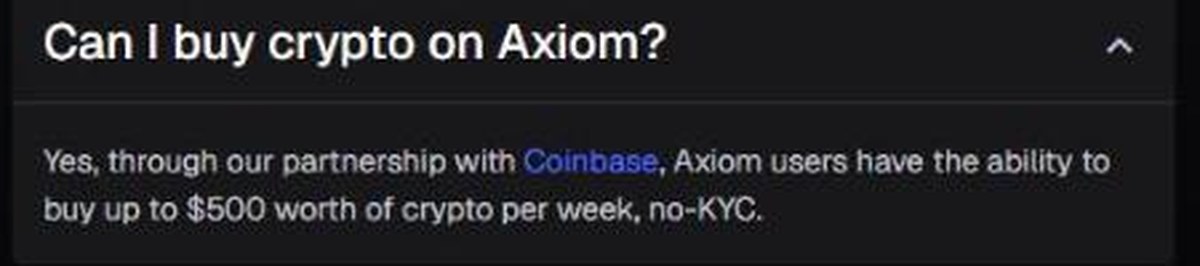
Capital has to arrive before it can earn, and Axiom routes that through a Coinbase integration. The documented flow is short — open the wallet menu, choose Deposit, choose Buy, enter an amount of SOL, confirm in the Coinbase popup — and the stated ceiling is $500 of crypto per week without KYC. The exact steps are set out in Axiom’s own deposit documentation.
For someone testing Axiom staking with a small amount, that is a sensible on-ramp: a regulated US exchange handles the card leg, and nothing more than an email is needed to start. It is also a hard cap. Anyone intending to stake a meaningful position will be funding by on-chain transfer instead, and should plan for that rather than discovering the weekly limit mid-deposit.
Who holds the keys
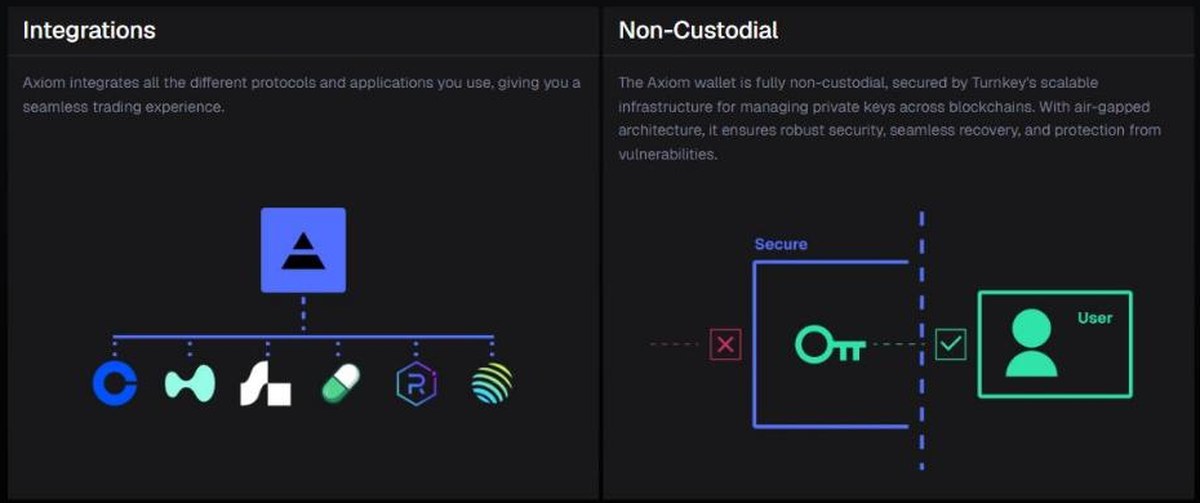
Axiom staking means leaving assets somewhere for a while, so custody is the question that decides whether the yield is worth anything. Axiom’s answer is that there is no custody: the wallet is “fully non-custodial, secured by Turnkey’s scalable infrastructure for managing private keys across blockchains”, with what the company calls an air-gapped architecture.
The Terms say the same thing in the language that actually binds: “Axiom does not store copies of Keys and does not custody your tokens, so Axiom cannot assist you in recovering your Digital Assets.” That is the honest shape of a non-custodial platform, and it cuts both ways. Axiom cannot freeze your stake, and Axiom cannot give it back to you either. There is no password reset at the end of this road.
Naming Turnkey is worth something: it is an identifiable key-management provider rather than an unnamed in-house system, which means the security claim can be researched instead of simply believed.
What trading costs while your capital sits there
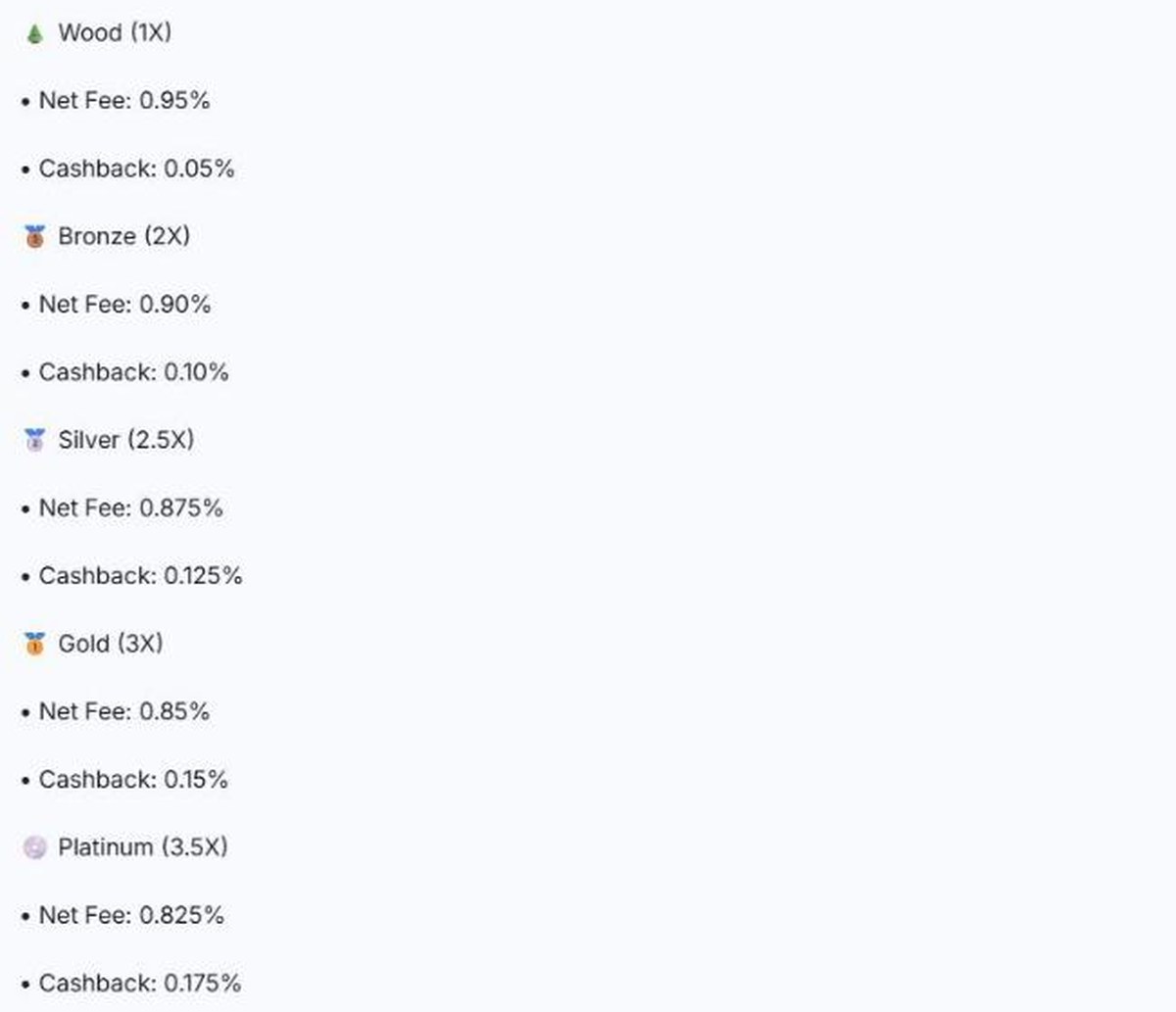
Yield is only half the ledger, and the case for Axiom staking weakens fast if the same capital is also being traded. Axiom publishes a seven-tier fee schedule that pays part of each trading fee back in Solana, and the tier rises with cumulative volume:
- Wood (1X) — net fee 0.95%, cashback 0.05%
- Bronze (2X) — net fee 0.90%, cashback 0.10%
- Silver (2.5X) — net fee 0.875%, cashback 0.125%
- Gold (3X) — net fee 0.85%, cashback 0.15%
- Platinum (3.5X) — net fee 0.825%, cashback 0.175%
- Diamond (4X) — net fee 0.80%, cashback 0.20%
- Champion (5X) — net fee 0.75%, cashback 0.25%
Publishing the whole ladder, including the worst tier, is more disclosure than many onchain front ends offer. The number to keep in view is the one at the top of the ladder rather than the bottom: a new account pays 0.95% a side, and a single round trip at that rate costs roughly three months of a typical Solana staking yield on the same capital. Earning and trading pull in opposite directions here, and the yield does not subsidise an active hand. Our longer look at the platform’s trading tools is in our earlier feature-by-feature walkthrough of the Axiom terminal.
Registration and licensing status
The Terms of Use name Axiom Innovations Inc. as the operator and describe the service as “a web-hosted user interface that can be used to connect with various decentralized finance (defi) protocols and smart contracts”. That framing is deliberate and it is accurate: Axiom positions itself as an interface, not as the venue where your trade settles or the institution that holds your money.
What follows from it should be stated plainly. Axiom holds no financial services licence from the FCA, ASIC, CySEC, MAS or any comparable authority. There is no segregated client-money rule, no statutory compensation scheme, and no ombudsman to escalate a dispute to. The UK regulator puts the consequence in one sentence: for cryptoasset-related investments, consumers are unlikely to have access to the Financial Ombudsman Service or the Financial Services Compensation Scheme if something goes wrong. A 15% advertised APY does not change that; it is exactly the kind of figure that guidance was written about.
The company’s backing is the one verifiable credential in the chain. Axiom states it has been funded by Y Combinator and appears in the accelerator’s company directory. That is evidence the business is real and reviewed by a serious investor. It is not supervision, and it protects no one’s deposit.
One further disclosure sits in the Terms and deserves a line of its own: the document describes the platform as being in a “limited beta phase”, provided “as-is” and “as-available”, with features that “may contain bugs or inaccuracies” and that Axiom may terminate or modify without notice. Readers sizing a staking position should read that clause in the current Terms before deciding how much capital belongs here.
Restricted users and jurisdictions
Axiom does not publish a country blacklist in the way a broker does. Instead the Terms define a Prohibited Person, and the definition does the work. You may not use the service if you are:
- subject to economic or trade sanctions by any governmental authority, including designation on the US Treasury’s Specially Designated Nationals list, the US Department of Commerce Denied Persons List or Entity List, the EU Consolidated List or the UK Consolidated List of Financial Sanctions Targets;
- located in, resident in or organised in any jurisdiction subject to comprehensive country-wide or regional sanctions, or designated “terrorist supporting” by the United Nations, the EU, the UK or the US;
- owned or controlled by any person or entity in the two categories above;
- under 18 years of age.
The Terms also place compliance squarely on the user: you are “solely responsible for complying with all applicable laws of the jurisdiction you are located or accessing the Services from”. Axiom reserves the right to block access and to share information with regulatory authorities where it suspects money laundering or other illegal activity. Because the list is defined by reference to sanctions registers rather than by naming countries, it changes without an announcement, and checking it is the user’s job.
Risk warning
Crypto assets are volatile and largely unregulated, and staking does not make them safe. Yield figures are forecasts, not guarantees: the Solana staking rate moves with network conditions, and a lending APY moves with borrower demand and can fall to near zero. A liquid staking token can trade below the value of the SOL behind it, so exiting axiSOL in a stressed market may cost more than the published 0.1% withdrawal fee.
Delegated stake is exposed to validator performance, and pooled stake is exposed to smart-contract risk in the stake pool program, however well audited. Because the wallet is non-custodial, losing access to your keys or credentials means losing the assets outright, with no recovery path and no one to appeal to. Axiom is not a licensed exchange, broker or bank: balances are not insured, there is no compensation scheme, and its own Terms describe the platform as being in beta and provided as-is. Nothing here is personal financial advice. Only commit capital you can afford to lose in full.
Who Axiom staking suits
It suits a Solana holder who is already comfortable with self-custody, wants their idle SOL delegated rather than sitting flat, and values a published 0% validator commission and a named, checkable validator address over a headline APY. For that person the direct route is the strongest version of the offer, and the ability to delegate from Ledger or Phantom means it can be used without handing anything over.
It does not suit anyone who needs a regulated counterparty, a recovery process or a guaranteed rate, and it does not suit anyone treating the advertised 15% as a fixed return. If the first description fits, the validator and axiSOL details are worth reading in full before any SOL moves. Readers comparing self-custody trading apps more broadly may also want our FOMO App review, which covers a different approach to the same problem.


